There is a moment I watch for at every reception. The portraits are done, cocktail hour has wound down, you have been introduced, and you finally sit down for the first time all day. Who is beside you in that chair decides what the next hour feels like: twenty quiet minutes together, or a dinner party in full voice.
That is why I never treat sweetheart table vs head table as a furniture question. It is a question about hospitality and intimacy. It decides whether your attendants sit beside their partners, how easily guests can come over to you, what your photographer sees, and how the rest of the room gets planned around your seat. Sweetheart table or head table, neither one is the right answer. Each simply does something different to the room.
Below are the options, what each one quietly does, how to decide, who sits where, and the practical bits. One promise up front: you do not have to have either.
Sweetheart, Head, King's, or Family Table: The Options in Brief
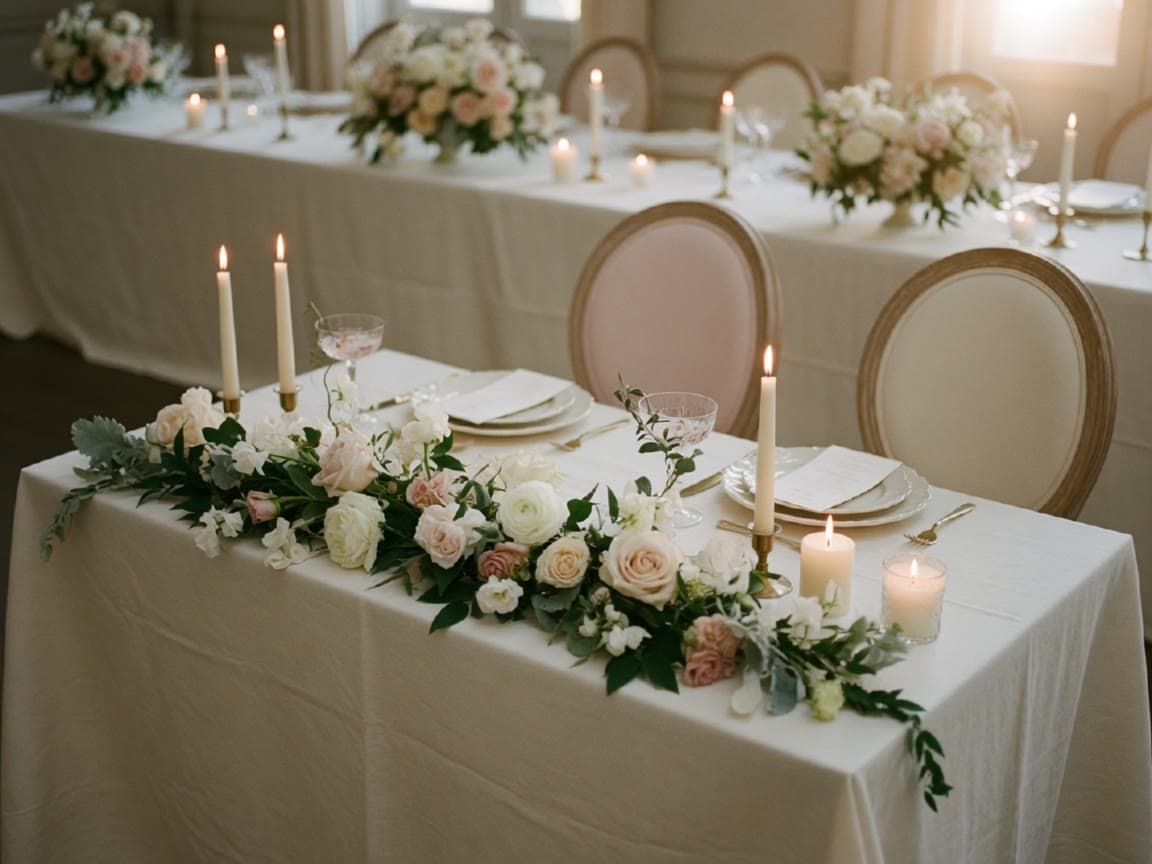
Sweetheart table. If you have wondered what a sweetheart table at a wedding actually is, it is a small table for just the two of you, usually facing the room, with your attendants and family at the closest tables.
Head table. Sometimes called the bridal party table, this is a long table seated on one side, facing your guests. You sit in the center, and your wedding party fans out on either side, sometimes with their partners, sometimes with parents.
King's table. A long table seated on both sides, usually the two of you plus your attendants and their partners, sometimes close family too. The Knot notes the name has fallen out of vogue, and many planners simply call it a long or double-sided head table now.
Family table, or sitting among guests. A regular or slightly larger table with parents, siblings, or your closest friends. At a small wedding, it can be one long feasting table for everyone.
In the UK, the head table is the "top table," and it traditionally includes parents alongside the couple and key attendants. Same decision, different default.
What a Sweetheart Table Quietly Does
The gift of a sweetheart table is time. This little table gives you a chance to actually eat, hold hands, and talk about the day while it is still warm. Inside Weddings calls it rare alone time, and I agree.
It also keeps your attendants with their dates. Nobody new to the friend group gets stranded at a table of strangers while their partner sits up front. And the small distance has a lovely side effect: it nudges you to stand up and visit tables.
There are practical gifts too. One small surface means less linen and fewer flowers to make it feel finished. And it can quietly settle tricky family seating, because no one has to be chosen, or not chosen, for the head table.
So, should you have a sweetheart table? Here are the trade-offs, said kindly:
- You are on display. Every bite is in view. Shy couples feel this more than they expect.
- It can feel isolated. Guests sometimes worry they are interrupting. My fix: wave people over, or plan a short table walk between courses.
- Some attendants may feel less honored. My fix: seat them at the nearest tables, name them in a toast, and take a group photo before dinner.
What a Head Table Quietly Does
A head table gives you company. Your people are right there, and that settles post-ceremony nerves and keeps the energy up through dinner. Inside Weddings adds that it honors your wedding party visibly, and guests tend to feel less separated from you.
It is also the classic focal point. Because everyone is lined up facing the room, speeches and group photos happen naturally. And it can reduce the number of guest tables you need, since the wedding party comes out of the round-table count.
The trade-offs are real:
- Partners get split up unless you add them, which makes the table longer.
- It needs a long wall and a wide, clear line in front of it.
- More linen and florals to cover a long run of joined tables.
- The far ends cannot talk to each other. One-sided seating means you mostly speak to your neighbors.
- It gets awkward at length. My rule of thumb, not a rule: past roughly 10 to 12 people on one straight side, it starts to feel like a panel rather than a dinner.
For a head table wedding seating plan, a straight line along one wall is the default. In a wide room, a gentle crescent helps the ends see each other, and a low riser can help sight lines.
Middle Paths: King's Tables and Family Tables
The king's table (or double-sided head table)
For a kings table wedding layout, you sit at the center of one long side, facing the room, with attendants and their partners on both sides and sometimes close family at the ends. What it does: keeps partners together, makes real conversation possible, and feels like a dinner party inside the wedding.
What it costs: a big footprint of several joined tables, a little less romance, harder to slip out, and photos that often catch someone mid-bite. Keep long centerpieces low so faces stay visible across the table.
A family table, or sitting among guests
At an intimate wedding, a sweetheart table can feel oddly distant from a room that is already close. The Knot suggests that with 30 or fewer guests, a large feasting table for everyone may suit better. If that is your kind of day, our piece on the micro wedding is worth a read.
Sitting at a round with your parents and siblings, or with your closest friends, is a real choice, not a missing item. Another variant: a sweetheart table flanked by two long tables for the wedding party and their dates.
Do you have to have a sweetheart table? No. A head table? Also no. The Knot states plainly that no etiquette rule requires one.
How to Decide Which One Fits Your Room
When couples ask whether they need a sweetheart table, these are the questions I ask back:
- How many guests? Small rooms often lean toward a family table. In larger rooms, either option reads clearly as the focal point.
- How big is the wedding party? A handful of attendants plus dates fits a head or king's table gracefully. A very large party on one straight line gets unwieldy.
- Who has a partner coming? Will anyone new to your group be stranded? Plus-one thinking starts with the guest list.
- What are the family dynamics? Divorced or remarried parents, a sibling who would feel left out, a friend group with history. A sweetheart table can take the politics off the table. Our etiquette guide covers the wider seating diplomacy.
- How do you both feel under attention? Do you recharge as a pair, or do you want your people around you? Be honest about both of you.
- What shape is the venue? Is there a long wall? Where is the dance floor? A narrow room may not hold a long head table and a dance floor comfortably.
- What do you want in the photographs? Quiet frames of the two of you at dinner, or a row of laughing friends?
The right answer is the one that matches the dinner you want to have.
Who Sits Where, Either Way
At a head table
You sit in the center. In the traditional bride-and-groom convention, The Knot places the bride on the groom's right; any couple can simply choose. Honor attendants sit nearest you, with the rest fanning out.
The old rule sent partners to other tables. The Knot says that rule is now largely ignored, and if honor attendants have plus-ones, seat them at the head table too. In the US, parents usually sit at a table of honor close by rather than at the head table itself.
With a sweetheart table
Zola's seating chart guide suggests placing the wedding party, with their partners, at the one or two tables nearest you. Parents come next, often sharing a table with grandparents and siblings who are not in the wedding party. If divorced parents do not get along, let each host their own table, kept equally close.
The Practical Bits: Placement, Size, and Numbering
Where to put it
Face the room, in the spot with the best view of the dance floor that most guest tables can see. Speakers and the two of you should be able to see each other, because even the best wedding speech lands better face to face. Stay close enough to the floor that the first dance flows straight from dinner.
Avoid the spot beside the speakers, the kitchen door, or a bright window behind you, which backlights every photo. Keep the wedding party and parents' tables nearest.
What size is a sweetheart table
Typically about 3 to 4 feet. A 48-inch round is a common pick, and a small rectangle or half-moon with both chairs on one side works well too. Larger rounds can look sparse for two. Confirm with your venue or rental inventory.
Does the sweetheart table get a number?
Usually it does not need one on escort cards, since you know where you are sitting. A head table is often treated as table 1. Either way, it belongs on the caterer's floor plan. For how guests find their seats, see escort cards vs place cards.
What it does to your guest-table count
A head table pulls the wedding party, and maybe partners, out of the rounds. Seatplan, a seating planner's blog, puts that at 10 to 14 people, often one or two fewer guest tables. A sweetheart table removes only your two seats. For where dinner and toasts fall in the day, see the wedding day timeline.
Keeping It Simple
Simple sweetheart table ideas are usually the best ones. Plain linen, low candles, and one or two arrangements you can see over are plenty. Once you sit, your bouquet can become the centerpiece, which is both pretty and practical.
A backdrop is optional. If your ceremony arch or florals can be moved, reuse them behind you and let them work twice.
For a head table, keep runners low so the room can see faces, and make the far ends as finished as the middle. The guests at the end tables are looking at those ends all night.
That is the whole styling brief. The table is there to frame the two of you, not to compete with you.
FAQ
What is a sweetheart table at a wedding?
A small table for just the two of you, usually facing the room, with your wedding party and family at the nearest tables.
Do you have to have a sweetheart table or a head table?
No. A family table, sitting among guests, or one long feasting table are all real choices.
What's the difference between a king's table and a head table?
A head table is seated on one side, facing guests. A king's table is seated on both sides, usually includes partners, and leans toward conversation over presentation.
Who sits at the head table at a wedding?
The two of you and your honor attendants, often the full wedding party and their partners. In the US, parents usually sit at a nearby table of honor. In the UK, they traditionally join the top table.
Does the sweetheart table get a number?
Usually not on escort cards, but it should still appear on the floor plan.
Before you sign the floor plan:
- How many guests, and how many attendants with partners?
- Do we want twenty quiet minutes, or dinner in conversation?
- Will anyone be stranded or feel left out?
- Does the room have the wall and sight lines for a long table?
- Where are toasts and the first dance happening, and can we see them?
- Would we honestly rather just sit with our family?
There is no correct table. The seat you choose sets the temperature of dinner: a quiet table for two, a long row of laughing friends, a crowded family round. Choose the feeling you want to have when you finally sit down.
And if neither option feels like you, skip both. Whatever you choose, sit down, eat something, look up at the room, and let the people who came for you come to you.