
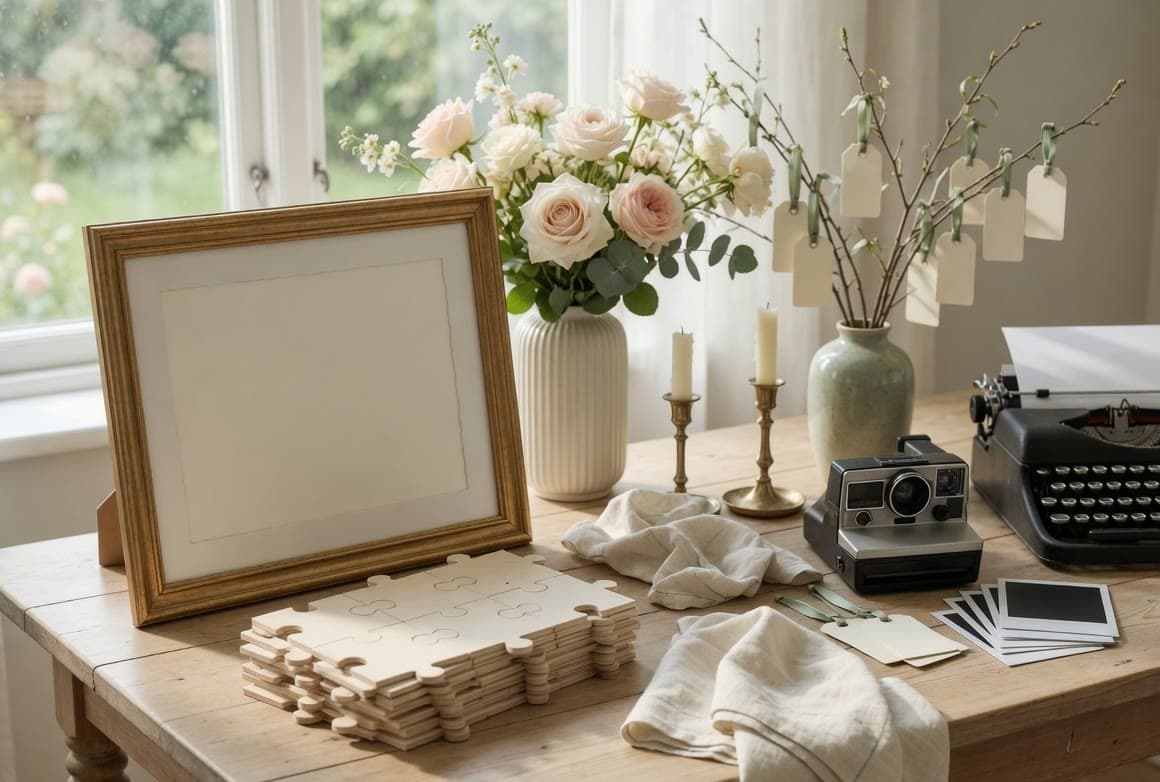
After the flowers fade and the dress is bagged, one small thing can still hold the day. The guest book, or whatever you put in its place, is that quiet keep: handwriting, faces, voices, or an object you will live with long after the last song.
Here is the short answer. You do not need a guest book. Zola calls it by no means a mandatory detail, and wedding planner Jill Gordon, quoted by The Knot, puts it plainly: guest books are not a need, but they are another fun memento of the day. What a guest book is for now is a keepsake of who stood with you. Choose by what you want to open in ten years, not by what a checklist expects. According to The Knot 2025 Real Weddings Study, 70 percent of couples still opt for some kind of guest book, even as the form keeps changing.
This is not a favor and not a card box. If that welcome table is already crowded, see do you need wedding favors.
The Classic Linen Book, Done Well
What it leaves you with is handwriting. Pages you can flip on an anniversary without a login or a charger.
A traditional guest book is a bound journal with blank or lined pages where guests leave wishes, congratulations, and advice, as Zola describes. Done well, it is more than a pretty prop.
First, put a prompt on the table or a small card inside the book so "Congrats!" is not the whole page. Second, pre-sign the first page yourselves, or ask parents or the wedding party to go first, so the first guest is not staring at blank paper. Third, assign someone to tend the station or walk the book mid-reception. Zola suggests asking a friend to carry it table to table about halfway through. WeddingWire likewise recommends stationing someone by the table and using clear signage.
Place the book where people naturally pause: an entryway table or en route to the bathrooms (Zola), or right at the reception entrance (WeddingWire). Test the pens. Pack a spare.
The trade-off is simple. Guest effort is low, so the book is easy to ignore without a sign or an attendant. Left alone, it can become a closet object you never open, which is the habit Junebug Weddings warns against when couples choose something they will not revisit. Relative cost sits in the Low tier: a book, pens, and a simple sign.
Alternatives, by What They Leave You With
Skip the product parade. Pick a format by the keepsake, then weigh setup, guest effort, and what you actually take home. Cost here stays relative: Low, Mid, or Higher.
Voices: an audio guest book. Guests leave spoken messages on a phone set out at the reception, or by dialing in or scanning a code on their own phones, as The Knot's audio guide explains. What you keep is tone: laughter, pauses, a grandmother's voice. Set the phone in a visible spot away from loud speakers. Alaa El Ghatit, quoted by The Knot, stresses clear signage and a DJ or band reminder. Outdoors, confirm power or battery life, and shelter the phone if rain comes, because these devices are not waterproof. Guest effort is medium. Relative cost lands Mid to Higher for a dedicated phone, and usually Mid for dial-in or QR audio. Plan a listening date once the files arrive.
Faces and motion: video. A video guest book is a compilation of short clips guests record on a kiosk or through a QR code or link on their phones, per The Knot's video guide. What you keep is faces and gestures. QR and link paths are lighter on gear and can include people who could not attend. A kiosk needs a visible, quieter pocket and sits higher on relative cost (Mid for QR or link, Higher for a kiosk). Audio is often less self-conscious. Video needs better light and a bit more bravery. Pick by whether you want to hear them or see them.
Faces on paper: an instant-film book. Guests snap a photo, wait for it to develop, mount it, and write a note. Planner Angela Olinick, quoted by The Knot, likes this path because you get the written memory and a face beside it. Jessie Whitfield, founder of MISGIF, quoted by Brides, suggests about one camera for every 40 guests. Olinick tells couples to buy enough film to cover each adult guest twice, because retries happen. Add a book with pockets or photo corners, pens, an instruction sign, and decent light. Ask the wedding party to go first, and have the DJ announce the station. Guest effort is high. Film runs out. Some guests keep the cute print. A simpler Brides tip: write on the Polaroid itself and album the prints later. Relative cost: Mid, mostly from cameras and film.
An object on the wall. Guests sign a print, a fingerprint or signature tree, a vinyl record, a globe, or another keepsake object, ideas that show up across The Knot's alternatives roundup, WeddingWire, and Junebug. What you keep is something you can hang or shelf. Provide paint pens that work on the surface and a sample signature so guests know the scale. Guest effort is low to medium; long advice does not fit. Relative cost: Low to Mid.
Delayed paper: postcards or time-capsule letters. Guests write now; you open later. Zola describes postcards held by a maid of honor and mailed through the first year. The Knot and WeddingWire echo anniversary bottles, wish jars, and scrolls. What you keep is a ritual. Set out cards, prompts, and a marked box, and assign one trusted person to hold them. Guest effort is medium. Relative cost: Low.
A QR album. Guests scan a code and upload photos, notes, or short clips into a shared gallery, a digital path The Knot and Junebug both describe. What you keep is a cloud album you must download and back up. Test the code on both phone types before the day. Relative cost: Low to Mid. Tech-comfortable crowds sail; mixed-age rooms need a helper at the sign.
When Guests Sign, and Where the Table Lives
Ceremony entrance is quiet and early, but late arrivals miss it and a bottleneck can form at the doors.
Cocktail hour is the best natural window. People are standing and talking. Keep the station out of the bar crush, and put length questions in the cocktail hour piece, not here.
Reception entrance or welcome table is the placement WeddingWire and Zola favor. It often shares space with escort display; seating stationery belongs to escort cards vs place cards.
Mid-reception, have a friend walk a classic book or a stack of prompt cards table to table (Zola).
Mark the station on your wedding day timeline so the DJ knows when to nudge. At the table itself: a sign at eye level, working pens, a sample page or demo photo, a cup for pen lids, and enough light for film or video.
Sign Wording, Prompts, and What Guests Can Write
Audio and Polaroid stations especially need steps, not only a cute headline. El Ghatit, via The Knot, says you have to tell people what to expect even when the instructions feel simple.
Original sign lines that work:
- Classic: "Leave us a few lines we can open on a quiet Sunday."
- Audio: "1. Pick up the phone. 2. Listen for our hello. 3. Wait for the beep. 4. Tell us a story or a wish. 5. Hang up to save it."
- Polaroid: "Snap once, wait for the picture, stick it in, then write us something only you would say."
- QR: "Scan, add a photo or a note, no app to download."
Prompt cards that pull real messages: "How did you know we would last?" "What should we cook on a Tuesday in year five?" "One piece of advice you learned the hard way." "A memory of us you hope we never forget."
Short samples for the page itself. Warm: "We love the way you look at each other. Keep that." Lightly funny: "May your Wi-Fi stay strong and your coffee stay shared." From parents: "We prayed for this room full of people. Take good care of each other inside it." For longer guest-facing help, see what to write in a wedding guest book.
Small Weddings, and What You Want to Keep
On a small guest list you will remember every face, so skipping is fine. Zola's permission still holds. If you want a keep anyway, prefer low-effort formats: a classic book, a signed print, or prompt cards. Film-heavy stations and kiosks ask more than an intimate night usually needs. A walked book is easy when the room is small.
Chooser, in one breath. Want handwriting you can reread: classic book or postcards. Want faces on paper: Polaroid book or signed photo print. Want voices: audio phone or QR audio. Want moving faces: video QR or booth. Want something on the wall: print, tree, record, or object. Want a ritual across years: time-capsule letters. If the budget is tight, a simple book or a DIY prompt-card box still counts. Put the money into photography instead.
Keeping It Alive After the Day
Download and back up audio, video, and QR albums within a week. Write the date on the spine or first page of a classic book. Frame a signed print once the ink is dry. On an anniversary, play three audio messages, open one letter, or read one Polaroid page with coffee. That is how Junebug's "actually revisit" test becomes a habit. And if you know you will never open it, skip it. Better none than a prop you resent.
FAQ
Do you need a wedding guest book?
No. It is optional. Zola and Gordon via The Knot both say so.
What is the point of a wedding guest book?
A place for wishes and a keepsake of who celebrated with you that you can reopen later (Zola; WeddingWire).
What is an audio guest book?
A phone, dial-in, or QR setup that records spoken messages you keep as audio (The Knot).
Audio vs video guest book?
Audio keeps voices with less self-consciousness. Video keeps faces and needs better light. QR paths for either can include remote guests (The Knot).
How does a Polaroid guest book work?
Guests shoot instant film, mount the print, and write a note. Plan about one camera per 40 guests (Brides/Whitfield) and film for each adult twice (The Knot/Olinick), plus a clear sign.
When do guests sign the guest book?
Often during cocktail hour or at the reception entrance. Ceremony doors and a mid-reception walk are options (Zola; WeddingWire).
What should a guest book sign say?
Where it is, what to do, and a prompt. Keep the steps short.
What should guests write?
Something true in their voice. Use the short samples above, or the linked what-to-write guide for more.
Are guest books worth it for a small wedding?
Only if you will reopen them. Choose low-effort formats, or skip with a clear conscience.
Checklist
- Decide what you want to keep: handwriting, faces, voices, or an object.
- Pick one primary format (two at most) so guests are not asked to perform three tasks.
- Assign a person to tend the station or walk the book.
- Write the sign and one prompt; test pens, film, batteries, and any QR on both phone types.
- Place the station on the day timeline and tell the DJ when to mention it.
- Plan the after: back up files, frame the print, or schedule the first anniversary listen.
The guest book is not proof you had a real wedding. It is a small archive of the people who showed up. Choose the form you will actually touch again.
Set the station, free your guests from a blank page with a prompt, and let the rest of the night be the party. Years later, open it on purpose.