
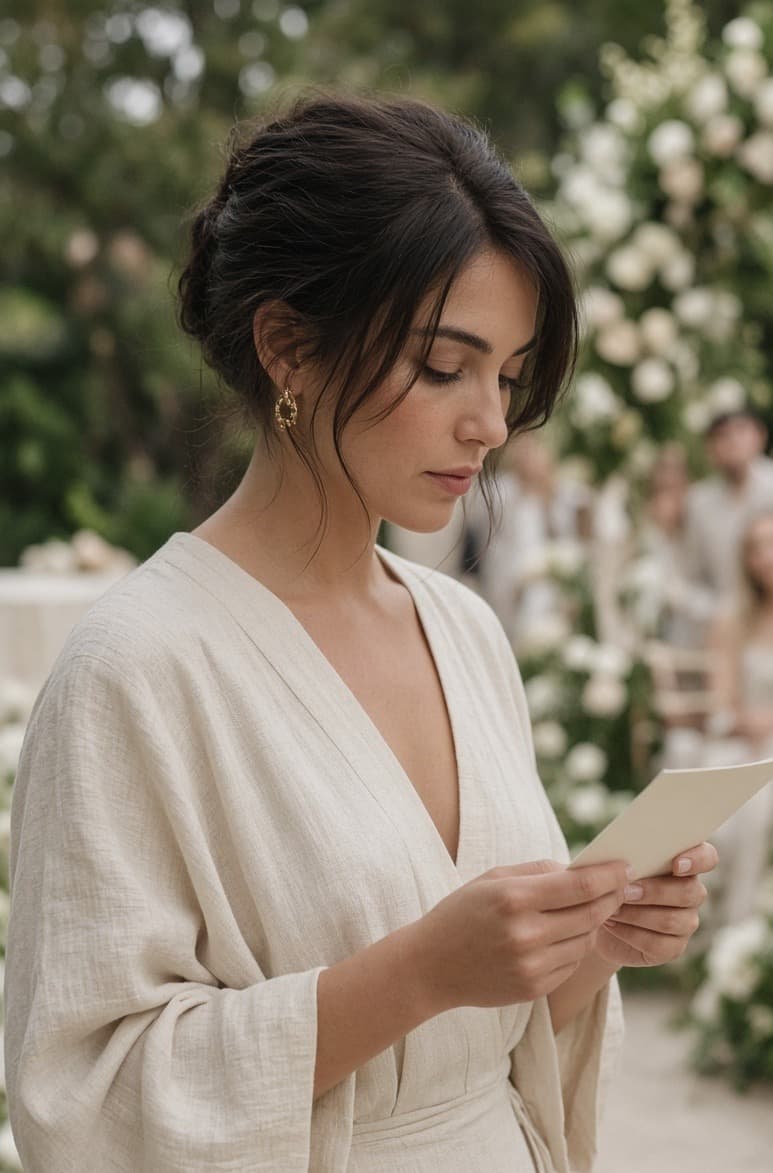
In a compact ceremony, the room is already listening hard. A reading is another voice entering that quiet. It is not decoration on a program. It can personalize the service, deepen the tone before the vows, and bring someone you love into the spoken part of the day, which is how wedding officiant Maria Northcott describes the job in The Knot's ceremony readings guide.
Ceremony lengths vary by format and tradition. For typical ranges, see how long should a wedding ceremony be. What follows is how to choose a text that sounds right aloud, ask a willing reader, keep the length kind, and prepare them with the exact words. Or how to skip the reading when your ceremony form allows it.
Do You Need a Reading, and What It Is For
For many secular and personalized ceremonies, you do not have to include a reading. WeddingWire says ceremony readings are completely optional, and you should not add one only to fill time. The Knot's sample ceremony scripts likewise treat readings as an optional beat.
When you do want one, it is usually for a few quiet reasons. It lets a voice other than the officiant's be heard. It sets a mood before you speak your own promises. It gives a meaningful role to someone who is not already in the wedding party, a use noted by Brides, Zola, and The Knot.
That is not the same as saying a reading is the only moment someone besides the two of you and the officiant can speak. Blessings, personal stories, cultural rites, and unity explanations can also belong in a ceremony. A reading is one tool, not the whole toolbox.
Some religious and cultural ceremonies require set readings or scripture, and some houses of worship limit what may be added. Talk with your officiant, celebrant, or clergy early about what is required, optional, or restricted before you cut, rewrite, or invent. Do not freestyle a sacred text without their guidance.
A reading is also not your vows and not a reception toast. For the promises you write yourselves, see how to write wedding vows. For speeches later in the night, see wedding speech ideas.
Choose for the Ear, Then Check the Clock
Choose by sound, not by how the passage looks on a screen. Read every candidate out loud, slowly, the way it will be heard in a quiet room. If a passage is hard to say at home, practice it until it feels natural, or choose simpler wording. Prefer short sentences, concrete images, and lines you can finish on one breath. Time the text at a careful pace before you commit, which is WeddingWire's practical test as well.
When the ceremony is flexible, plan each reading for about one to three minutes aloud, and keep the whole readings portion near or under about five minutes. WeddingWire and Brides both use that band. The Knot likewise suggests keeping the readings section under five minutes. Anything longer usually needs a shorter selection, or a different passage, unless your tradition requires a fixed text.
How many? Often one or two. Brides recommends one to two, with three as a firm upper limit for most couples. WeddingWire and The Knot offer similar guidance. Add more only when a religious or cultural template asks for it, or when the ceremony is deliberately built around several short voices.
For a secular poem or prose piece, choose a short, clearly attributed excerpt that still reads as a coherent whole, and keep the author's wording intact. If you want to adapt the text, ask about permission where that applies; this is not a legal guide, only a reminder to be careful. For sacred or prescribed texts, use the wording your officiant or tradition provides.
Outdoors, in heat, or with a standing crowd, shorter is often kinder. Ask your officiant where the reading should sit. A common pattern is after the welcome and before the vows, but content and tradition can move it, as The Knot and WeddingWire both note. There is no single correct minute for every wedding.
Literary, Spiritual, or Plain
Tone is a choice about the room you want.
Literary means poem or prose with imagery and cadence. It can be beautiful in a steady voice and flat in a rushed one. Match it to a reader who will honor the music of the lines.
Spiritual or scriptural means you use your tradition's approved texts and translations. Confirm language, length, and who may read with clergy or your officiant. Keep the choice respectful of the form you are celebrating, and ask before you substitute something else.
Plain means a few clear sentences about partnership, home, or chosen family. Plain text is often the kindest choice for a first-time reader. It can be something written for the day, as long as you label original words as your own and keep them short.
Modern or unexpected material, from a favorite book to a letter you already treasure, can work if it passes the aloud test and your officiant's rules. WeddingWire encourages choosing favorites that feel true to you. Keep the tone of the whole ceremony in mind. A light line can belong if it still sounds like you and fits the room.
For a nonreligious ceremony, secular text is normal. Still ask whether the venue or celebrant has content limits.
Who to Ask, and How to Ask
Cast for the voice, not for family rank.
Zola's guide to wedding readers puts the real tests up front: comfort with public speaking, closeness to both of you, and a calm backup plan. Brides adds that a reading is a graceful way to honor someone who does not otherwise have a role. Tanya Pushkine, quoted by The Knot in those sample ceremony scripts, puts it simply: choose someone who will be comfortable speaking in public, and choose a reading that resonates with you both.
Good fits often include a grandparent, a sibling who is not already overloaded, a longtime friend outside the wedding party, a godparent, or the person who introduced you. Northcott's advice, shared by The Knot, is to match the person to the text. An advice passage suits a long-married pair. A warmer, lighter piece needs someone with timing. A dense literary passage needs a steady reader.
When you ask, offer a graceful way to decline. Celebrant Katherine Hunter suggests inviting the person to say whether they feel comfortable presenting it, or whom they would recommend instead. Hand them the exact final text in that same conversation. Polka Dot Wedding makes the same point: do not promise "we'll send it closer to the day." They need time to sit with the words and practice.
Name a quiet backup, often someone already in the wedding party, so a last-minute illness does not strand the ceremony. Zola recommends that approach. If you are considering a child as a reader, ask whether they feel comfortable speaking in front of the room, and plan a rehearsal so they can try the words and the standing place ahead of time. Choose someone else if the idea makes them tense.
Give Them the Exact Text, Then Rehearse
Print the reading in large type. Mark pauses. Note any names or pronunciations. Tell them where they will sit, when they stand, and whether there is a microphone. The Knot advises seating readers near the front or along the aisle so they can rise easily; they do not need to walk in the formal processional.
Ask them to practice aloud more than once, and to attend the ceremony rehearsal so the cue feels familiar. Hunter notes that a reading inside the service is not a reception speech. They should deliver the text you chose, not add stories, jokes, or congratulations mid-aisle. Save that warmth for later.
If you are printing programs, listing the reader and the title helps guests follow along. More on what belongs on that page is in do you need wedding programs.
Two Short Passages, and One Plain Original
Here are a few examples to read aloud, not a long list of options. Notice where you need air, and whether the voice feels right for your reader.
From William Shakespeare's Sonnet 116, public domain text via MIT Shakespeare:
Let me not to the marriage of true minds Admit impediments. Love is not love Which alters when it alteration finds, Or bends with the remover to remove:
It sounds formal, even, and a little abstract. The short lines help a nervous reader if the pace stays slow. Because the sonnet is widely known, a steady delivery matters more than speed. Give the words room, and let the listener meet them freshly.
From Elizabeth Barrett Browning's "How do I love thee?" in Sonnets from the Portuguese, public domain text via Project Gutenberg:
How do I love thee? Let me count the ways. I love thee to the depth and breadth and height My soul can reach, when feeling out of sight For the ends of Being and ideal Grace.
It sounds intimate, because it addresses someone directly and builds by accumulation. It is easy to push the volume too high. Coach the reader to keep the list warm, not shouted.
And here is a tiny plain example written for this guide (original, not a quotation from another author). It is meant for a friend or family member to read about the couple, not for the couple to speak as vows:
Marriage is the daily work of two people who choose to build a life side by side. It asks for patience on ordinary mornings and courage when the day is hard. May this partnership stay kind, steady, and glad to begin again.
Use it only if it fits your tone. Better still, write two or three third-person sentences of your own, attribute them clearly as original if you use them, and time them aloud.
If nothing you try earns the silence of the room, you may skip the reading when your ceremony form permits it.
FAQ
Do you have to have a reading at a wedding?
Often no, for flexible secular ceremonies. WeddingWire calls readings completely optional. Some religious and cultural forms require them. Ask your officiant.
What does a reader do at a wedding?
They deliver a chosen text during the ceremony. It is not a vow and not a reception speech.
How long should a wedding reading be?
About one to three minutes each, with the readings portion near or under about five minutes when you have a choice, according to WeddingWire and Brides. Time the text slowly before you lock it in.
Who should do a reading?
Someone willing, audible, and close to both of you, often a VIP who is not already in the wedding party. Zola, Brides, and The Knot all put comfort and fit ahead of hierarchy.
How do you choose the text?
Start by reading candidates aloud. Match the tone to your ceremony. Confirm rules with the officiant. Look to authors and books you already love, which is Northcott's advice as shared by The Knot.
What should you give the reader in advance?
The exact final text early, plus logistics for seating, cue, microphone, and rehearsal.
Can you skip or shorten a reading?
Yes when the ceremony allows. For secular material, prefer a short, clearly attributed excerpt that still makes sense on its own. Sacred or prescribed texts may be fixed; follow your officiant.
Where does a reading sit in the ceremony?
Often after the welcome and before the vows. Content and tradition can move it. Confirm the order rather than assuming every wedding uses the same sequence.
Checklist
- Ask the officiant what is required, optional, or restricted.
- Decide to skip, use one reading, or use two (three only with a clear reason).
- Shortlist by reading aloud, timing the text, and choosing a coherent excerpt.
- Cast a willing reader and a quiet backup; hand over the exact text when you ask.
- Print large-type copies; rehearse standing with the real cue and microphone plan.
- Note the reader and title on the program if you are using one.
A reading is a borrowed voice for a few minutes of truth. If no text earns its silence, you do not owe the room a poem.
Choose for the ear, prepare the person who will carry it, and let the vows stay the center of the day.