
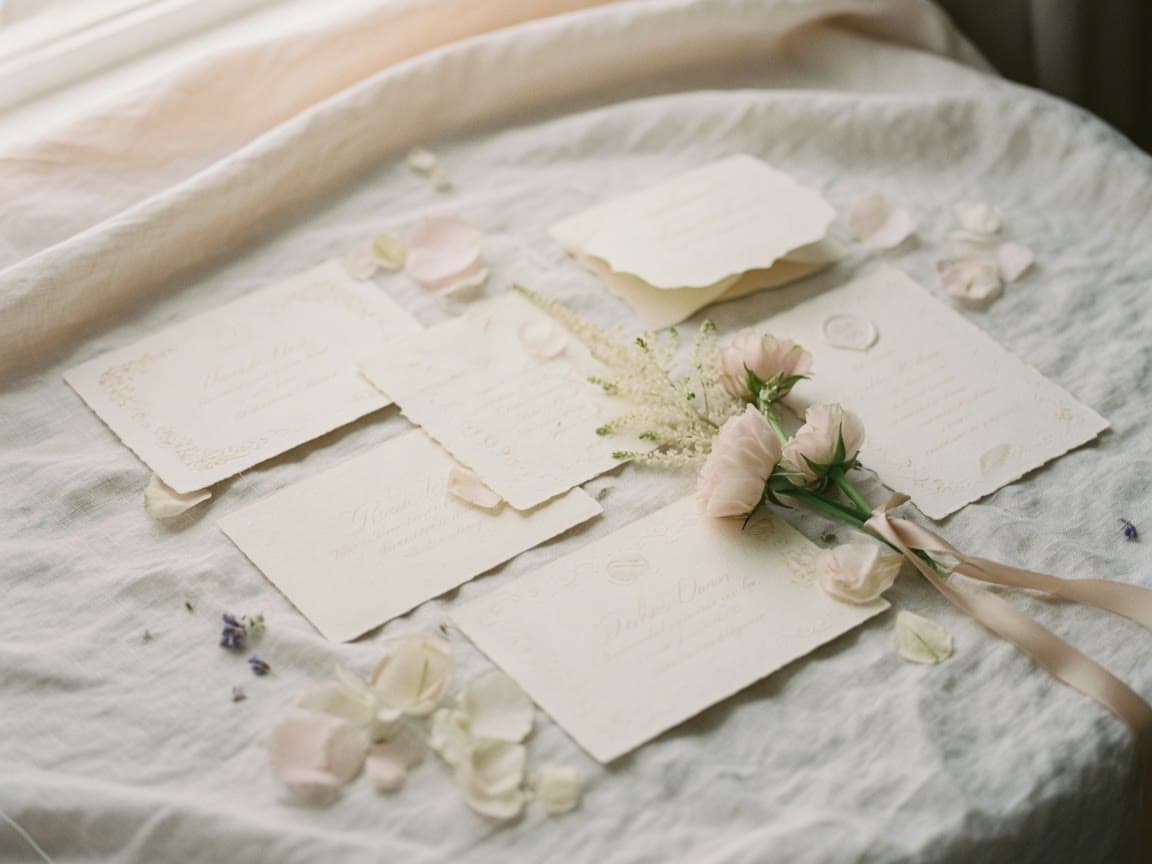
When couples ask me about escort cards vs place cards, they usually think they are shopping stationery. They are not. They are deciding how guests walk into the reception: with a calm table number in hand, or hunting for a name at every setting. The short answer is simple. Escort cards assign a table at the door. Place cards assign an exact seat at the setting. That difference quietly shapes formality, meal service, and whether your entrance feels gracious or chaotic.
I have planned rooms where guests floated in with a smile and rooms where fifty people circled the same table looking for "Table 7" while the salad wilted. The paper is small. The logistics are not. Stationery will never fix a bad seating plan, but the right cards (or chart) will keep a good plan from falling apart at the door. If you are sorting the difference between escort cards and place cards, start here: one is a welcome at the threshold, the other is a seat assignment once you arrive.
What Are Escort Cards (and How Do Escort Cards Work at Weddings)
What are escort cards? Per Zola's escort card guide and Brides, wedding escort cards tell each guest which table to join, not which chair. They usually sit near the reception entrance (or just outside it) so people can find their name before they step fully into the room. Guests pick up the card, spot their table number, and choose any open seat at that table unless you also set place cards.
How do escort cards work at weddings in practice? I alphabetize them. Full first and last names. Clear table numbers (no Roman numerals, and I underline nines so they never look like sixes). The display can be a simple table, a hanging wall of cards, or something a little more playful as long as the names stay easy to read. Creativity is welcome. Confusion is not. A pretty display that takes five minutes to decode is not hospitality. It is a bottleneck.
Escort cards feel less formal than place cards because they leave a little freedom at the table. Couples who want seated dinner conversation without micromanaging every chair often stop here. Wedding seating cards of this kind also help caterers and venues see head counts by table. When your guest list is large, that alone is worth the ink.
I tell couples to place the display where the natural path from cocktail hour meets the reception doors. One clear sign. Enough space for a small line without blocking the bar. That is how escort cards earn their keep: they turn "Where do we sit?" into a thirty-second stop instead of a group wander.
What Place Cards Are (and When They Belong)
Place cards are different. They sit at the place setting and assign the exact seat. Brides and Zola both frame them as the more formal option: name, sometimes a meal mark, right there on the china or tucked into the napkin. Guests do not choose a chair. The chair chooses them.
I reach for wedding place cards when the dinner is plated with dual entrées, when VIPs need specific neighbors, or when the room is formal enough that open seating at a table would feel unfinished. Place cards with meal choice markings are especially useful for servers. A tiny symbol or color code on the card tells the team who ordered fish, who ordered vegetarian, and who needs the allergy plate, without a whispered quiz mid-service.
Seating cards vs place cards is mostly vocabulary. When people say "seating cards," they often mean either escort or place. I keep the terms separate with couples so nobody designs the wrong piece. Place cards alone do not replace a way to find the table. They only mark the seat once you are already there.
Do I need place cards at my wedding? Only if you want assigned seats, clearer plated service, or a more formal table presence. Plenty of warm, well-run receptions stop at escort cards or a seating chart and let friends settle themselves at the assigned table. Formality is a dial, not a law.
Escort Cards vs Place Cards: The Core Comparison
Here is the difference between escort cards and place cards the way I sketch it on a planning call:
| Escort cards | Place cards | |
|---|---|---|
| What they assign | Table only | Exact seat |
| Where they live | Entrance display (alphabetical) | At each place setting |
| Formality | More relaxed | More formal |
| Guest freedom | Any chair at that table | Fixed seat |
| Meal markings | Possible, less precise for servers | Clearer for plated dual entrée |
| Best paired with | Strong table numbers; optional place cards | Escort cards or a seating chart so guests find the table first |
Do you need escort cards and place cards? Sometimes both. Escort (or a chart) gets people to the right table. Place cards finish the job with exact seats. Using both is common for black-tie dinners, complicated family dynamics, or plated menus with several entrée options. Using escort alone is common for receptions that are seated by table but socially flexible once guests arrive.
I have planned both setups in the same season. The "both" path feels polished. The escort-only path feels warm and efficient. Neither is wrong. What fails is mixing the tools without a plan: place cards with no chart or escort, or a gorgeous escort wall that does not match the table numbers inside.
Escort Cards vs Seating Chart
Escort cards vs seating chart is the other fork couples hit. A seating chart is one large display that lists names next to table numbers. Brides' guidance is the one I echo: generally use a chart or escort cards, not both. They do the same job at the door. Doubling them usually creates two lines and twice the looking.
Do you need escort cards if you have a seating chart? Usually no. The chart already assigns the table. You can still add place cards at the settings if you want exact seats. That combo (chart at the entrance, place cards at dinner) is clean and common.
Large guest lists often prefer an alphabetical seating chart because one board is faster than fishing for one card in a sea of calligraphy. Smaller or more design-forward weddings often love individual escort cards because the display can feel personal. Either way, keep table numbers huge and consistent. The assignment system only works if Table 12 looks like Table 12 from across the room.
A light practical note: whatever system you choose, proof the names against your final RSVP list the week of. Nicknames, plus-ones, and last-minute meal changes are where escort cards, charts, and place cards all trip. I would rather reprint ten cards than watch someone hunt for a name that was never there.
How Guests Actually Enter the Room (Cocktail Hour Into Reception)
This choice lives in the transition after cocktail hour. Guests are already social, slightly buzzed, and ready to sit. Your job is to move them into dinner without a scavenger hunt.
With escort cards or a clear seating chart at the threshold, the flow is orderly. People pause, find a name, then walk toward a numbered table. Soft music and open doors help. A coordinator or usher nearby helps more. Give the display a little breathing room so the line never blocks the entrance. Chaos shows up when there is no assignment at all and a hundred people invent their own seating plan in real time. Friends claim entire tables. Couples get split. Empty seats appear in odd clusters while other tables overflow. That scramble is avoidable, and it is almost always a planning choice rather than bad luck.
Place cards alone, without a chart or escort display, create a different mess. WeddingWire warns that guests end up wandering table to table searching for their name. I have watched it. It looks polite until it is not. Everyone is smiling and slightly stranded.
You can skip both only for a truly informal backyard gathering with ample scattered seating, which is the caveat Brides allows. If the day is lawn chairs, buffet, and "sit where you like," fine. If you are serving a plated meal in a ballroom, give people a map.
Modern wedding etiquette here is less about old rules and more about kindness. Guests should never feel stupid finding dinner. Your entrance stationery is how you show that kindness before the first toast.
Meal Choices, Formality, and When You Need Both
Escort cards with meal choice markings can work. A small icon, initial, or colored dot on the escort card tells the guest (and sometimes the kitchen) what was ordered. Place cards with meal choice markings are clearer for plated dual entrée service because the mark sits with the person who will eat the meal. Servers love that. So do I.
Formally speaking, place cards raise the temperature of the room. Escort cards keep it lighter. When do you need both? When you want table assignment plus exact seats: formal dinners, complex family seating, or venues that require precise entrée placement. When escort alone is enough: most seated receptions where friends can choose chairs within their assigned table. When a chart replaces escort: same door job, different display style. Place cards can still ride along either way.
I also nudge couples to think about accessibility. Large print, high contrast, and a staffer who knows the layout beat a tiny script no one can read in dim light. Pretty paper should still do its job.
If you are still shaping the broader day, nailing the wedding day timeline helps you see where this entrance moment sits between cocktails and dinner. The stationery decision is small on the checklist and huge in the first five minutes of the reception.
A Practical Checklist Before You Print
Before you order paper, walk through this with your planner or venue:
- Decide the assignment level: table only, or table plus exact seat.
- Choose one door system: wedding escort cards or a seating chart (not both).
- Add place cards only if you want assigned seats or clearer plated meal marks.
- Alphabetize names. Use full names. Match spellings to RSVPs.
- Confirm table numbers are identical on cards, chart, and table signage.
- Mark meal choices where servers will actually see them.
- Place the display on the natural path from cocktail hour into the room.
- Assign someone to restock or answer questions for the first ten minutes.
- Skip the whole system only for a truly informal backyard with plenty of open seating.
- Do a final name-and-meal proof the week of the wedding.
That list sounds fussy. It prevents the soft panic of fifty people asking the same question at once.
When escort cards vs place cards finally clicks for a couple, the room feels different. Guests arrive like they were expected. Tables fill without drama. Dinner can start on time because nobody is still circling. Stationery will not make the marriage. It will make the first minutes of the party feel considered, which is half of what good hosting is.
I tell couples to pick the lightest system that still protects their guests. Escort cards for most seated receptions. Place cards when seats and meals need precision. A seating chart when one board beats a hundred little cards. Use both only when the dinner asks for it. Then step back and let people find their places with ease. That quiet entrance is the whole point, and it is one of the kindest details you can plan.
If you remember nothing else, remember this: assign the table at the door, assign the seat only if the dinner needs it, and never leave guests hunting. That is how the room opens well.