
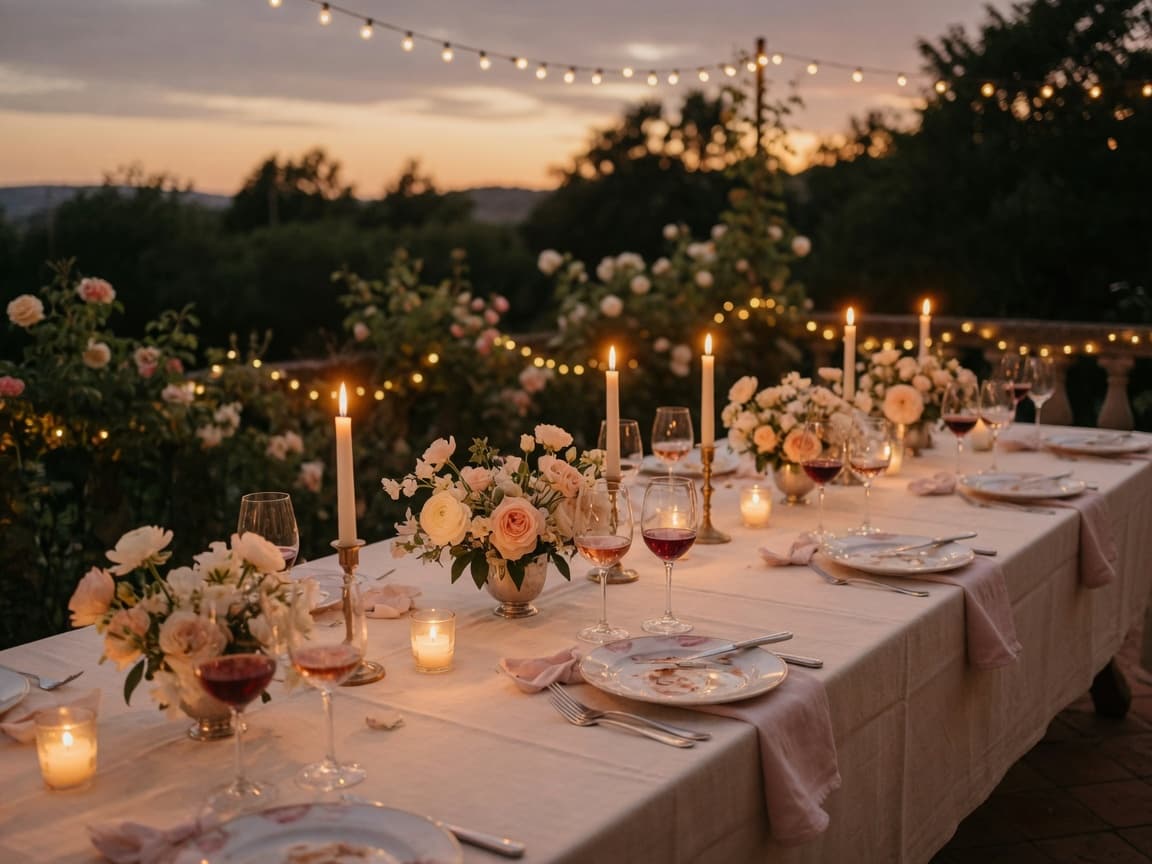
Picture the evening before your wedding. The rehearsal has wrapped, or there was no rehearsal at all, and the light is going soft. Maybe the evening holds a long table of your closest people telling the stories they have saved for years. Maybe it holds a loose, happy room where everyone who traveled finally says hello.
I never treat rehearsal dinner vs welcome party as one more line on a checklist. It decides who you spend your last unmarried evening with. It decides whether your guests meet as strangers at the reception or as people who already shared a drink. And it decides how much energy the two of you carry into the morning. Rehearsal dinner or welcome party, neither is the right answer. Each one simply does something different to the night before.
One promise up front: you can host one, both, or neither, and all three are fine.
Rehearsal Dinner, Welcome Party, or Welcome Drinks: The Options in Brief
Rehearsal dinner. The traditional meal after the ceremony walk-through, usually the evening before, for your wedding party, close family, the officiant, and partners. Often seated, often with toasts. As Emily Post points out, "there's no rule that says the event has to be a dinner." A lunch or brunch after an earlier rehearsal works just as well.
The rehearsal itself. Entrances, positions, and cues with your officiant and wedding party. For who walks when, see wedding processional order. The meal and the rehearsal are separate things, and you can rehearse without a dinner.
Welcome party. A wider, more casual gathering, usually the night before, open to all your guests or at least everyone who traveled. Mingling matters more than seating.
Welcome drinks. The lightest version: an hour or two at a bar, a terrace, or the hotel lounge. Brides notes that either food or drinks is acceptable for a welcome event held separately from a dinner. But if it runs through dinnertime, feed people dinner.
Neither. A quiet night, a family pizza, or nothing planned at all. That is a real option too.
What a Rehearsal Dinner Quietly Does
The gift of a rehearsal dinner is closeness. Emily Post describes the atmosphere as "more personal and private than the wedding reception," and that matches what I see. Your closest people can actually hear each other.
It also makes room for the toasts that will not fit tomorrow. The long stories, the funny ones, the gifts for your attendants: they all have a home here. (If someone is nervous about speaking, our wedding speech ideas will help.)
It may be the first time the two families properly meet, as Emily Post notes, so tomorrow's hugs are not first introductions. And it is steadying. The walk-through is done, the people who will stand beside you are fed and laughing, and your nerves have somewhere to settle.
So, do you need a rehearsal dinner? Here are the trade-offs, said kindly:
- Travelers can be left on their own. Guests who arrived early may spend the evening at the hotel bar unless you plan something light for them.
- Guest-list politics. Someone will wonder why they were not at the table. A clear, private invitation and a consistent rule for who is included solve most of it.
- It is another hosted meal. Emily Post's one rule helps here: the rehearsal "should never be more formal or more lavish than the wedding reception."
- Emotional fullness. An evening of heartfelt toasts can leave a tender couple wrung out. Give it an end time and keep it.
What a Welcome Party Quietly Does
The quiet heart of a welcome party is the ice it breaks. A planner quoted in Brides says it "serves the purpose of breaking the conversational ice so that the wedding day will feel more like a warm meeting of friends." I have watched guests who met over a drink the night before arrive at the ceremony already waving at each other.
It also honors travel. People who spent money and vacation days to come get an evening with you, not a lonely hotel room. For a destination wedding especially, both The Knot and Brides see it as a gesture of gratitude. And it gives you time with people you will only wave at tomorrow, because the wedding day moves fast.
The trade-offs:
- Your energy. A big room the night before is a second, smaller wedding. Introverted couples feel this.
- Late nights. Guests who stay out too long arrive tired to the ceremony. The Knot suggests roughly two to three hours.
- Food expectations. The Knot is blunt: "Please don't host a welcome party at dinnertime without actual dinner."
- Inclusion. If only travelers are invited, local guests may hear about it. Invite privately rather than on a public page.
So, do you need a welcome party? No. The Knot itself calls it "technically optional." It is a kindness, not an obligation.
Both, Neither, or Something in Between
Hosting both
Can you have both a rehearsal dinner and a welcome party? Yes. The usual pattern is an intimate dinner for family and the wedding party, then a wider gathering afterward. Zola suggests a small dinner, then drinks at a nearby bar for everyone else.
Brides suggests a different location for each, so a long dinner does not spill into an arriving crowd, and both food and drinks if they overlap.
This is the longest evening of the weekend, so build in a hard stop for the two of you, even if friends stay on. Or move the welcome event to an afternoon or earlier day.
Folding them into one
You can also make the rehearsal dinner the welcome party by opening it to everyone, or to everyone who traveled. This works beautifully for smaller weddings and for a micro wedding, where the two guest lists are nearly the same people anyway. Emily Post's rule still applies: keep it a notch less formal than the wedding.
Neither
A simple ceremony may not need a rehearsal, and no rehearsal needs a dinner after it. One gentle thought: if people give up their evening to rehearse with you, it is kind to thank them with something, even drinks or a stack of pizzas. I offer that as hospitality, not a rule.
A quiet night with your partner or your family is a perfectly good choice. If that is your plan, here are a few things to do the day before your wedding.
Should you have a rehearsal dinner? Only if you want what it gives. Emily Post calls hosting one "customary, but not obligatory." One, both, or neither, you are not getting it wrong.
How to Decide What Your Night Before Needs
When couples ask me whether to plan a rehearsal dinner or welcome party, these are the questions I put on the table:
- How many guests are traveling? Lots of travelers lean toward a welcome event. A mostly local list may not need one.
- Do your families know each other? If not, a smaller dinner gives them a proper first evening together.
- How complex is the ceremony? A big wedding party, young children, or cultural rituals usually earn a real rehearsal, and a meal tends to follow.
- What restores your energy? Inner circle or full room? Be honest about both of you.
- Who is offering to host? A family that wants to host may shape the answer.
- How do you want to feel at 9 pm? A long table of stories, a loud happy room, or bed.
There is no winner here. Choose the evening that leaves you most like yourselves in the morning.
Who to Invite to Each
The rehearsal dinner guest list
For who to invite to a rehearsal dinner, start with the core Emily Post and Zola describe: your wedding party and their partners, the officiant and their partner, parents and stepparents, grandparents, siblings who are not in the wedding party, and the parents of any child attendants (with the children too, if the setting suits). Add anyone with a ceremony role, such as readers.
It is kind to include your attendants' dates; Zola calls it good form. For your wider plus-one approach, see finding the perfect wedding guest list.
Beyond that, Emily Post notes, "any number of people may be invited, including out-of-town guests." Today the welcome party usually carries that job.
With blended families, everyone who is family to you belongs. Seat them thoughtfully.
The welcome party guest list
For a wedding welcome party, who to invite is simpler. The Knot says inviting all your guests is "the best option if you can swing it," and if not, at least everyone who traveled. This is where the welcome party vs rehearsal dinner question for out-of-town guests usually settles itself.
If it is not open to everyone, invite privately rather than on the public wedding website. Either way, The Knot suggests giving it its own RSVP.
Who Pays, and Who Hosts
So who pays for the rehearsal dinner? Traditionally, the groom's family hosts it. Emily Post calls this "customary, but not obligatory." For same-sex couples, or any couple outside that frame, the tradition simply translates to "the family not hosting the wedding," if anyone wants a tradition at all. Couples of any gender can follow it however suits them.
The modern reality is more relaxed. Zola puts it plainly: "Nowadays, it's not uncommon for couples to pay for the dinner themselves, or have both sides of the family split costs." Our modern guide to wedding etiquette says much the same.
A welcome party has no fixed tradition. The Knot notes it is often the couple, sometimes parents splitting it, or the side not paying for the wedding.
Hosting comes with the first toast, since the host speaks first. Brides suggests saving parent toasts for the wedding day and letting friends carry the welcome party.
If you are paying for either, put it in your wedding budget checklist early.
A Few Practical Notes
Timing. Usually the evening before. A welcome event can move to the afternoon, or to two nights before, if travel or the rehearsal crowds the evening.
Location. Close to the ceremony site or the hotel most guests are using.
End time. Give both events a finish, and tell people what it is.
Invitations. A separate card, a personal message, or a website RSVP all work. Emily Post suggests sending rehearsal dinner invitations roughly three to six weeks ahead, a sensible typical range.
Formality. Keep both a notch below the wedding, with a dress code on the invitation. The wedding-day schedule itself lives in our wedding day timeline.
FAQ
Do you need a rehearsal dinner?
No. It is customary, not required. If you do hold a rehearsal, thank the people who gave you their evening, even simply.
What is the difference between a rehearsal dinner and a welcome party?
Guest list and tone. A rehearsal dinner is an intimate, often seated meal for the wedding party and close family. A welcome party is a wider, looser gathering for all guests or everyone who traveled.
Can you have both a rehearsal dinner and a welcome party?
Yes. Host a small dinner, then a wider gathering afterward, ideally in a different spot.
Who pays for the rehearsal dinner?
Traditionally the groom's family. Today it is often the couple, either family, or both families sharing it.
Who should be invited to a welcome party?
Ideally everyone on the wedding guest list, or at least everyone who traveled.
Are welcome drinks enough?
Yes, as long as it is clearly drinks and not over dinnertime. If it runs through dinner, serve dinner.
Before you plan the night before:
- How many guests are traveling, and when do they arrive?
- Do our families need a first proper evening together?
- Do we need a real rehearsal, and who is in it?
- Who is offering to host, and what does that change?
- How much energy do we want to keep for the morning?
- Would we honestly rather have a quiet night?
There is no correct night before. A long table of stories, a loud room of travelers saying hello, both, or a quiet supper for two: each one quietly sets the pace of the weekend. Choose the evening that sends you into the wedding day feeling like yourselves.
And remember that one, both, or neither is fine. Whatever you choose, end it on time, eat something, and go to bed knowing the people who came for you are already glad they did.