
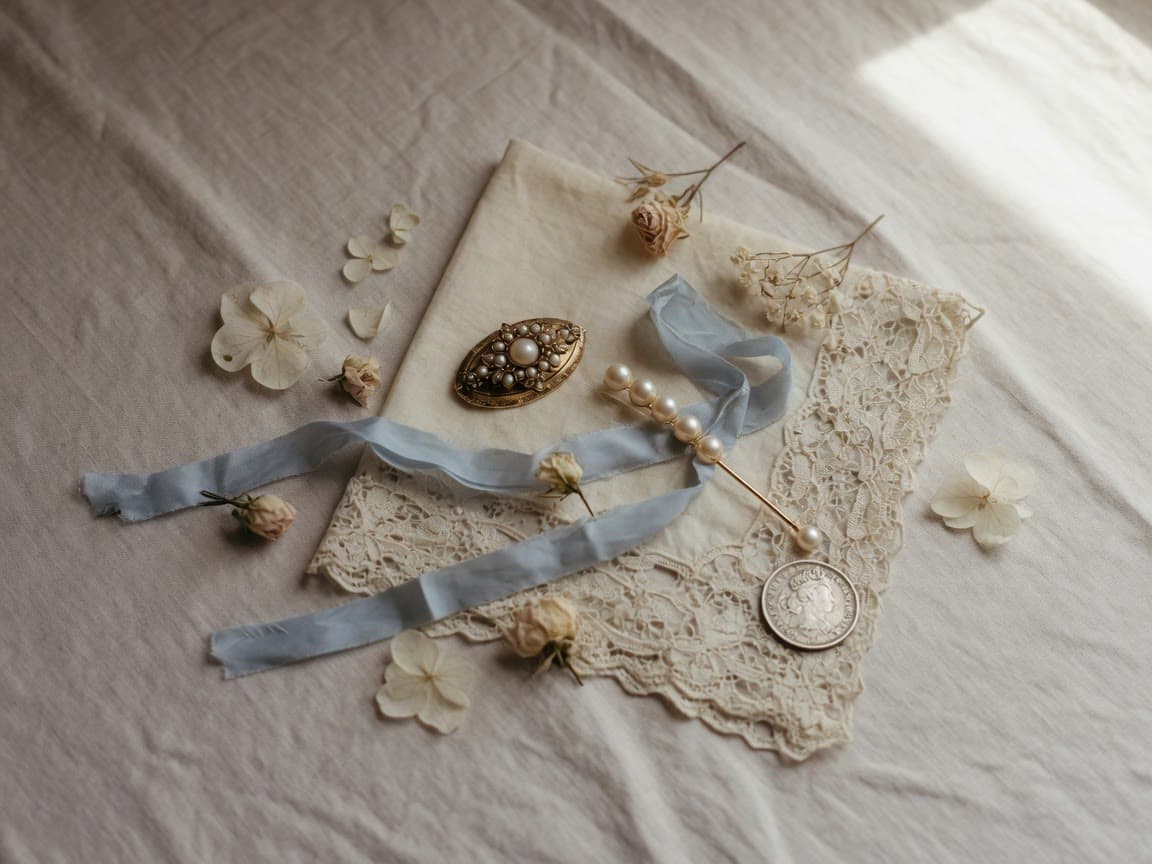
There are ten quiet minutes before every aisle that I have learned to protect. The dress is on, the photographer has stepped out, and someone you love leans in. A grandmother presses a folded handkerchief into your palm. A friend fastens her earrings in your ears. Your mother checks the hem one last time, and you both know there is a little blue thread stitched inside it that nobody else will ever see.
That is the meaning of something old, something new, something borrowed, something blue, as I have come to understand it. It is not a scavenger hunt or a list to tick off at 2 a.m. It is a small ritual that lets the people who love you put something in your hands before you walk.
Below is where the rhyme comes from, what each of the four quietly carries, a few considered something old something new something borrowed something blue ideas, the sixpence, and who traditionally gives what. One promise up front: you can follow it to the letter, bend it to fit your family, or skip it entirely. All three are fine.
Where the Rhyme Comes From
Before there was a rhyme, there was a superstition. According to Phrase Finder, the English folklorist William Henderson recorded the belief that a bride should wear something borrowed in 1866.
The rhyme took shape soon after. In 1871, a story in the London publication St James' Magazine had a bride-to-be say she must "wear something new, something borrowed, something blue." That is almost the current form, though notice that "something old" has not arrived yet. The first example of the version we use today is American, from the Pennsylvania newspaper the Lancaster Intelligencer in August 1873: "Something old and something new, Something borrowed and something blue." So the rhyme crossed the Atlantic early, and it belongs to both sides of it.
The full poem, with its late Victorian last line, goes like this:
Something old, something new, Something borrowed, something blue, And a silver sixpence in her shoe.
The V&A is honest that the rhyme's exact origins are uncertain, though references are frequent from the late Victorian period onward. You may also read that the items were meant to ward off the evil eye. That is a piece of folklore told about the rhyme, not something historians can confirm, so I hold it lightly.
The rhyme belongs to a whole family of wedding-day superstitions, like the tradition of not seeing the wedding dress before the ceremony. What I love about this one is that it asks other people to take part. As the V&A puts it, each item lets loved ones contribute, and each blesses the bride in a different way.
Something Old: Continuity
Something old carries the line back to the people who came before you. The V&A notes that the old item often holds a link to the bride's family, and in particular her maternal figures.
My favorite example comes from the V&A's own collection. When April Olrich married in 1963, she chose not to carry a bouquet at all. Instead she carried a small silver prayer book that had belonged to her great grandmother, dated 1905. I think about that often. She did not add the heirloom to her look. She let it replace something.
A few considered ideas:
- A piece of someone else's dress. A square of your mother's or grandmother's lace or satin, sewn inside your bodice or wrapped around your bouquet stems.
- A family piece, worn again. A brooch, a ring, a hair comb, or a veil that has already walked one aisle.
- A face to carry. A small photograph or locket tied to the bouquet for someone who cannot be there.
And if there are no heirlooms in your family, or none you can reach, that is not a gap in your day. Something old only has to be old to you. The first gift your partner ever gave you, a ring you have worn since you were sixteen, or a vintage piece you choose today as the first object in a line that starts with you. Every heirloom was new once.
Something New: Hope for What Comes Next
Something new carries the start of the new life, and the hope you bring to it. The V&A explains that the new item has tended to be the dress itself, because in the 18th and 19th centuries brides commonly rewore and altered their wedding dresses. The idea of a dress for a single day did not come about until the early 20th century. So the gown's first outing was the wedding, and it marked the beginning.
That still works beautifully. If your dress is your something new, enjoy knowing it, whether it is silk, crepe, or tulle (our guide to wedding dress fabric types has the details).
Other ways to carry new:
- Shoes or jewelry you chose for this day, and will wear again on anniversaries.
- Something engraved with the date, inside a bracelet or on the back of a watch.
- Something the two of you chose together, so the new thing belongs to the marriage, not just the outfit.
Here is the quiet trick: your something new can become someone else's something old. If you choose a piece with that in mind, say so out loud to the person you hope will carry it one day.
Something Borrowed: Happiness on Loan
Something borrowed is the tenderest of the four, I think. According to the V&A, the borrowed item was traditionally lent by a happily married female relative, in the hope that the bride might also borrow some of that marital happiness.
The V&A tells a lovely story here. When Princess Beatrice married Prince Henry of Battenberg in 1885, her mother, Queen Victoria, initially disapproved of the match. She had hoped her daughter would stay at home. In the end, the Queen lent Beatrice her own "dear wedding lace" for the ceremony, and with it, presumably, her love and support. That is exactly what a borrowed thing can say when words are hard.
A few considered ideas:
- Something from a married sister or friend. Earrings, a hair pin, or the comb that held her veil.
- Something from a parent. A handkerchief, a pair of cufflinks tied to your bouquet, a watch.
- Something from your bridesmaids. A bracelet or a pin, returned the same night, ideally with a note tucked into the box.
The custom says happily married, and many families honor that. But I have watched brides borrow from a best friend, a godmother, or a widowed grandmother whose love outlasted everything. Borrow from whoever's love you would like to carry. Then give it back, because returning it is part of the ritual.
Something Blue: Fidelity, Kept Close
So what does something blue mean for a wedding? The V&A notes that the color has long been associated with loyalty and faithfulness. It is the promise part of the rhyme.
The V&A holds one of my favorite examples of all. Tucked inside the hem of the dress Pamela Talmey wore when she married in 1969 are a little blue bow and a horseshoe. The dress was made by the designer Jean Muir, who stitched the charms discreetly out of sight, the V&A says, "serving as a joke or a comfort to the bride." I love that it was never meant to be seen.
That is my main advice for something blue: keep it close. A blue thread or your initials stitched inside the hem, or inside the bustle where only you will know. A blue ribbon wound around the bouquet stems. A small blue stone in an earring.
Something blue for the bride from mom is one of the sweetest versions I see. A sewn label inside the dress with a line in her handwriting, or a blue handkerchief she carried at her own wedding.
And for grooms: Vogue notes the tradition is not limited to brides. A blue suit lining, a thread inside the lapel, blue socks, or the ribbon on a boutonniere all do the job quietly.
The Sixpence in Her Shoe
The last line of the rhyme is a wish for luck and prosperity. The Royal Mint describes the sixpence as a lasting symbol of both, and says that for many years the father of the bride would slip one into his daughter's shoe before she walked down the aisle.
There is one practical snag. The Royal Mint notes the sixpence was introduced in 1551 and demonetised in 1980, so you will not find one in your change.
What to use instead:
- A real old sixpence, if someone in your family has kept one.
- A coin from a year that matters, the year you met, or the year you marry.
- A coin from your own country or family, a dime, or a coin a grandparent carried home from somewhere.
Tape it under the insole so it does not rattle around during the vows.
Who Gives Each One, and When
None of this is a rule, but here is how the custom usually runs:
- Something old often comes from a mother or grandmother, the maternal line the V&A describes.
- Something new is often chosen by the bride herself, or by the couple, sometimes with a parent.
- Something borrowed traditionally comes from a happily married relative or friend. Today it is often a bridesmaid.
- Something blue has no fixed giver. Mothers, maids of honor, and friends all give it.
- The sixpence was traditionally the father of the bride's to give.
As for when, the quiet minutes while you dress are the classic moment. But it does not have to be the morning. Items can be handed over the night before, at a rehearsal dinner or welcome party, so the giving gets its own moment instead of being lost in the rush.
Doubling Up, Spreading Them Out, or Skipping It
One object can carry two meanings. A vintage veil borrowed from your aunt is both old and borrowed. A new blue ribbon on your bouquet is both new and blue. Nobody is counting.
You can also spread the four across the weekend: something borrowed handed over at the rehearsal, something old at breakfast with your mother, something blue in the last minute before the aisle. Each one becomes its own small ceremony.
And do you have to do something old, new, borrowed, and blue? No. If one of the four means something to you, carry that one. If none of them does, skip it with a clear heart. A ritual you actually feel is worth more than four you simply check off.
FAQ
What does something old, something new, something borrowed, something blue mean?
Each item carries a blessing: old for continuity with family, new for the life ahead, borrowed for happiness lent from a happy marriage, and blue for loyalty and faithfulness.
What is the full poem?
"Something old, something new, something borrowed, something blue, and a silver sixpence in her shoe." The sixpence line is a late Victorian addition.
What does something blue mean for a wedding?
Loyalty and faithfulness. It is often hidden, inside a hem or wrapped around the bouquet.
Who gives the bride her something blue?
There is no fixed giver. Mothers, maids of honor, and close friends often do.
What does the sixpence in her shoe mean?
A wish for luck and prosperity, traditionally slipped in by the father of the bride.
Do you have to do all four?
No. Choose one, double up, or skip it entirely.
Before you get dressed:
- Whose love would I like to carry with me today?
- What do we already own that has a story?
- Who would I love to borrow from, and how will I give it back?
- Where can my something blue hide?
- Who will hand each one to me, and when?
- What am I starting that someone might carry one day?
The four things in the rhyme are small. A handkerchief, a pair of earrings, a ribbon, a coin. What they carry is not small at all. Each one is a way for someone who loves you to say so without a speech, and to come down the aisle with you even if they are sitting in the third row.
So take what means something and leave the rest. Hold your grandmother's lace, wear your best friend's earrings, let a blue thread hide in your hem, or carry nothing but your own two hands. However you walk, you will not walk alone.