
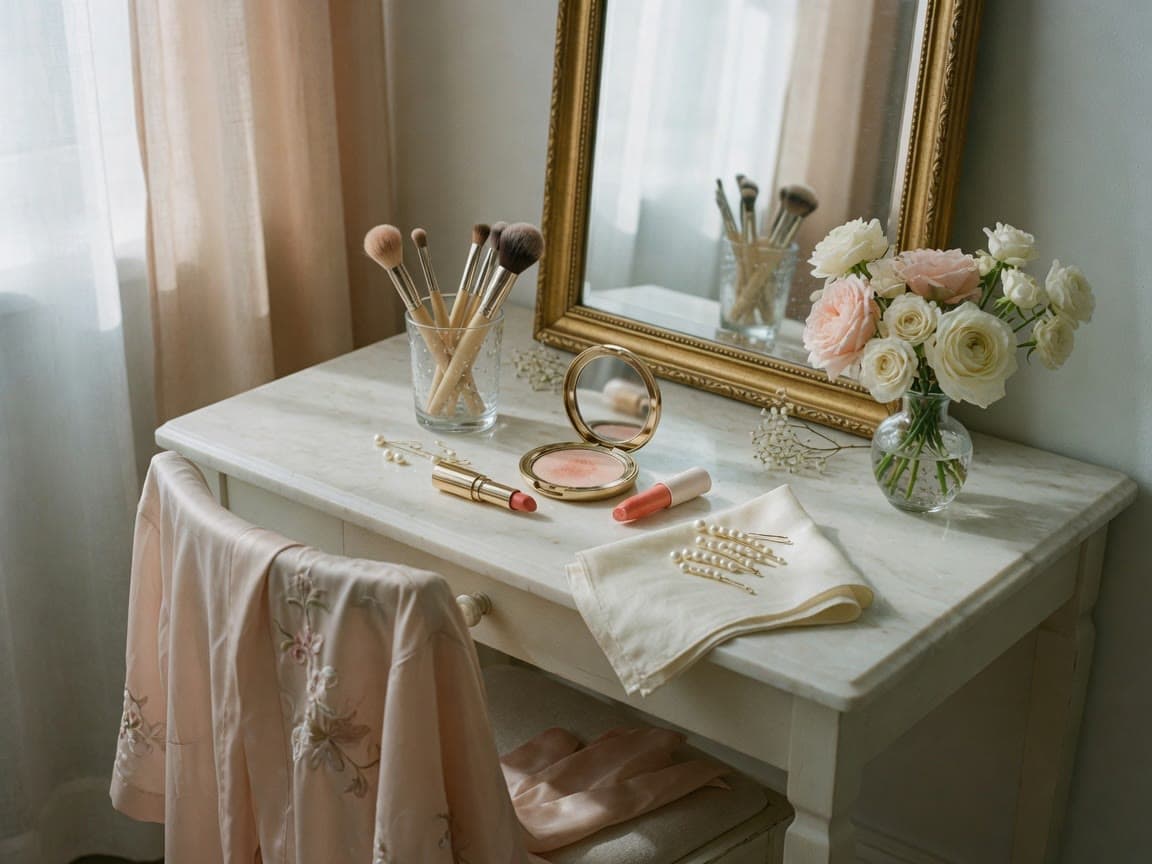
In the best bridal suites I know, at eleven in the morning, the light is soft, one bridesmaid is laughing in the chair, two more are in robes with their coffee, and the bride sits by the window with nowhere to be. In the other kind, it is 2:40, someone's curls are still in clips, and the bride steps into her dress with her heart pounding.
Same artists, same people. What changed was the schedule.
Your wedding hair and makeup timeline is the hidden structure of the morning. It decides who waits, where the calm minutes land, and how you feel when the dress finally goes on. There is no single right timing. What I can give you are honest ranges, a way to build your own schedule, and three sample mornings with the math done. For the rest of the day, see our guide to the wedding day timeline.
How Long Does Bridal Hair and Makeup Take?
Sources differ, so here they are side by side.
The Knot suggests two to three hours for the bride, one to two hours each for the maid of honor and bridesmaids, 30 minutes to one hour for flower girls and junior attendants, and about an hour for mothers and grandmothers. The makeup artist it quotes, Michelle Schultz, puts the whole morning at an average of four to six hours.
Brides and Zola both count by service instead: 60 to 90 minutes for the bride's hair and another 60 to 90 for her makeup, and 30 to 45 minutes per service for everyone else.
These agree more than they seem to. Two bridal services at 60 to 90 minutes come to two to three hours. For everyone else, two services at 30 to 45 minutes come to one to one and a half hours, the lower half of The Knot's range.
According to The Knot and Zola, the clock stretches with an ornate updo, long or thick hair, extensions, lashes, more people, and fewer artists.
So the truest answer is your own artist's number. Ask for it in minutes, per service, per person.
Work Backward From the Moment That Can't Move
Pick your fixed point: the ceremony, or your first look if you are having one. A first look pulls the whole morning earlier and gives hair and makeup a firmer finish time.
From that fixed point, subtract in order: the walk or drive to the ceremony, a quiet tucked-away cushion, photos, getting dressed, and touch-ups. The last person in the chair has to be finished by then. Then subtract every service, and your buffer, and you have your start time.
Brides suggests that a bride and a party of four start getting ready four to five hours before the ceremony. That is one source's guide for one party size, not a rule.
Give getting dressed real time, too, especially with laces, buttons, or a veil to settle.
How Many Artists, and Why One Means a Dawn Start
My rule of thumb as a planner, not a law: once about four or more people need services, consider a second artist, and around eight or more, a third. Count services rather than people, since hair and makeup for one person is two services.
Zola notes that two stylists can get everyone out the door in about half the time of one. You can see why in the arithmetic. In the party-of-six sample below, one artist doing everything would need 600 minutes of chair time, ten full hours. To finish at the same time, she would start before four in the morning. As Schultz told The Knot, "No one likes to be up at 5 a.m. for hair and makeup."
The quieter cost of one artist is the waiting: friends finished at nine, touched up at two.
Hair or Makeup First, and Where the Bride Sits
For each person, The Knot recommends hair first, then makeup. Heat and the warmth of styling can disturb fresh makeup, and finishing with makeup lets the artist blend cleanly at the hairline.
For the party, order is custom and varies. Brides suggests putting your most reliable bridesmaids first, and notes that mothers often want to go early so they are free to help. The Knot suggests starting with whoever has the longest, thickest hair.
As for the bride, the sources split. One artist quoted by Brides puts the bride last or second to last when there are no photos before the ceremony, and second to last if she is nervous, so she has time to relax before the dress. Another prefers the bride in the middle, for adjustments and a more leisurely pace. Zola says plainly that opinion is split, and The Knot's sample places the bride about midway. With a first look or early portraits, the bride goes earlier.
My own preference: near the end, but not the very last slot if you tend toward nerves. Leave yourself a half hour between the chair and the dress.
Put the Buffer Early, and Feed Everyone
The buffer belongs before the bride sits, not tacked onto the end. If someone runs late or a curl needs redoing, the slack gets absorbed early instead of landing on your dress time. Schultz's own cushion is for small, human things: five minutes to eat lunch, or to say hello to your photographer.
Eat. The Knot's sample morning begins with coffee, a light breakfast, and water. The Brides tipping guide suggests feeding your artists too.
The Knot notes artists usually arrive about 30 minutes early to set up, so count that in, and give them a well-lit spot near outlets.
Time your photographer for the details and your own chair. In the Brides sample, the photographer arrives during the bride's hair. Plan the rest of the photos in your wedding day timeline.
What the Trial Tells You About Timing
The Knot's trial guide calls trials optional but widely recommended, running one to three hours each, ideally one to three months before the wedding.
Treat yours as a stopwatch. Ask your artist to time your hair and your makeup separately, and whether the wedding-day version will take the same. The Knot also suggests wearing the look for a few hours and photographing it, to see how it holds. No trial in the budget? The Knot notes it matters less if you already trust your artist.
Doing Your Own, or a Smaller Team
You do not need a full professional team. Doing your own makeup, having a friend do your hair, or booking a pro for yourself only are all real, lovely choices.
Do one timed practice run at home, add a cushion, and schedule your own chair as firmly as an artist's. Bridesmaids can arrive already done, which keeps the room calm.
Who Pays, and Tipping
According to The Knot's bridesmaid etiquette guide, if you require professional hair and makeup, it is good etiquette for you to pay. If it is optional, bridesmaids can choose it and pay for themselves. Zola describes the tradition as the bride providing basic beauty services for her party, and advises deciding who pays before anything is booked. For more on who covers what, see our modern guide to wedding etiquette.
For tipping, The Knot's vendor tipping guide suggests 15 to 25 percent of the total bill for hair and makeup, given at the end of the service. Brides suggests 15 to 20 percent of the service fee, not counting add-ons or travel, and says whoever pays for a service covers its tip. Check your contract first in case gratuity is included, and put tips and beauty costs in your wedding budget checklist.
Three Sample Schedules
These are illustrations, not rules. Each assumes 45 minutes per service for everyone but the bride (the top of the Brides and Zola range), 75 minutes each for the bride's hair and makeup (150 minutes total, Schultz's two and a half hours), getting ready at the venue, artists arriving 30 minutes early, and 30 minutes to get dressed. Hair comes before makeup wherever the rotation allows.
A Small Party With One Artist
A 4:00 p.m. ceremony, no first look, the bride and two bridesmaids, and one artist doing both hair and makeup. That is 330 minutes of chair time plus a 30-minute buffer: six hours.
- 7:30 a.m.: Artist arrives and sets up
- 8:00: Bridesmaid 1, hair then makeup, until 9:30
- 9:30: Bridesmaid 2, hair then makeup, until 11:00
- 11:00: Buffer and lunch
- 11:30: Bride's hair, until 12:45
- 12:45 p.m.: Bride's makeup, until 2:00; photographer arrives
- 2:00: Bridesmaid touch-ups
- 2:15: Bride dresses
- 2:45: Photos with bridesmaids and family
- 3:30: Tucked away, water, quiet
- 4:00: Ceremony
A Party of Six With Two Artists
A 4:00 p.m. ceremony, no first look: the bride, maid of honor, three bridesmaids, and the bride's mother, with a hairstylist and a makeup artist working side by side. Each works 300 minutes. The mother has makeup first so both chairs start at once, and the buffer sits just before the bride's hair.
- 7:00 a.m.: Artists arrive and set up
- 7:30: Hair, maid of honor; makeup, mother
- 8:15: Hair, bridesmaid 1; makeup, maid of honor
- 9:00: Hair, bridesmaid 2; makeup, bridesmaid 1
- 9:45: Hair, bridesmaid 3; makeup, bridesmaid 2
- 10:30: Hair, mother; makeup, bridesmaid 3
- 11:15: Buffer and lunch
- 11:45: Bride's hair, until 1:00; photographer arrives about 12:45
- 1:00 p.m.: Bride's makeup, until 2:15
- 2:15: Touch-ups
- 2:30: Bride dresses
- 3:00: Photos with the party and family
- 3:40: Tucked away
- 4:00: Ceremony
With one artist instead, the same party is 600 minutes of work. With the same buffer and a 2:15 finish, she would begin at 3:45 a.m.
A First-Look Morning
The same party and two artists, a 4:00 p.m. ceremony, and a first look at 1:15. The bride sits in the middle so she is finished early, and the buffer comes before her makeup.
- 7:00 a.m.: Artists arrive and set up
- 7:30: Hair, maid of honor; makeup, mother
- 8:15: Hair, bridesmaid 1; makeup, maid of honor
- 9:00: Hair, bride, until 10:15; makeup, bridesmaid 1, until 9:45
- 9:45: Makeup artist's buffer
- 10:15: Hair, bridesmaid 2; makeup, bride, until 11:30
- 11:00: Hair, bridesmaid 3
- 11:30: Bride eats lunch; makeup, bridesmaid 2
- 11:45: Hair, mother, until 12:30
- 12:00 p.m.: Bride dresses
- 12:15: Makeup, bridesmaid 3, until 1:00
- 1:00: Bride's quick touch-up
- 1:15: First look
- 1:45: Couple, party, and family portraits
- 3:00: Rest and touch-ups
- 3:30: Tucked away before guests arrive
- 4:00: Ceremony
FAQ
How long does bridal hair and makeup take?
The Knot suggests two to three hours. Brides and Zola suggest 60 to 90 minutes each for hair and makeup.
How long does hair and makeup take per bridesmaid?
The Knot suggests one to two hours. Brides and Zola suggest 30 to 45 minutes per service.
Should the bride get hair or makeup done first?
Hair first, then makeup, according to The Knot.
Should the bride go first or last?
Sources split. I like near the end, with a half hour before the dress.
What time should hair and makeup start?
Work backward from your ceremony or first look. Brides suggests four to five hours ahead for a bride and four attendants.
How much do you tip wedding hair and makeup artists?
Brides suggests 15 to 20 percent and The Knot 15 to 25 percent.
Before you sign off on the schedule:
- What is our fixed point, the ceremony or a first look?
- How many services, and how many artists?
- Who goes first, and who needs to be free early?
- Where does the buffer sit?
- When does the photographer arrive, and when do we eat?
- Do I have a half hour between my chair and my dress?
When a morning schedule works, nobody notices it. What people remember is the coffee, the laughter in the chair, your mother's face when she sees you, and the last quiet minute before the dress.
So build the morning that lets you feel like yourself. One artist, a full team, or your own two hands at the mirror are all fine. Leave room to breathe, eat something, and step into your dress already calm.