
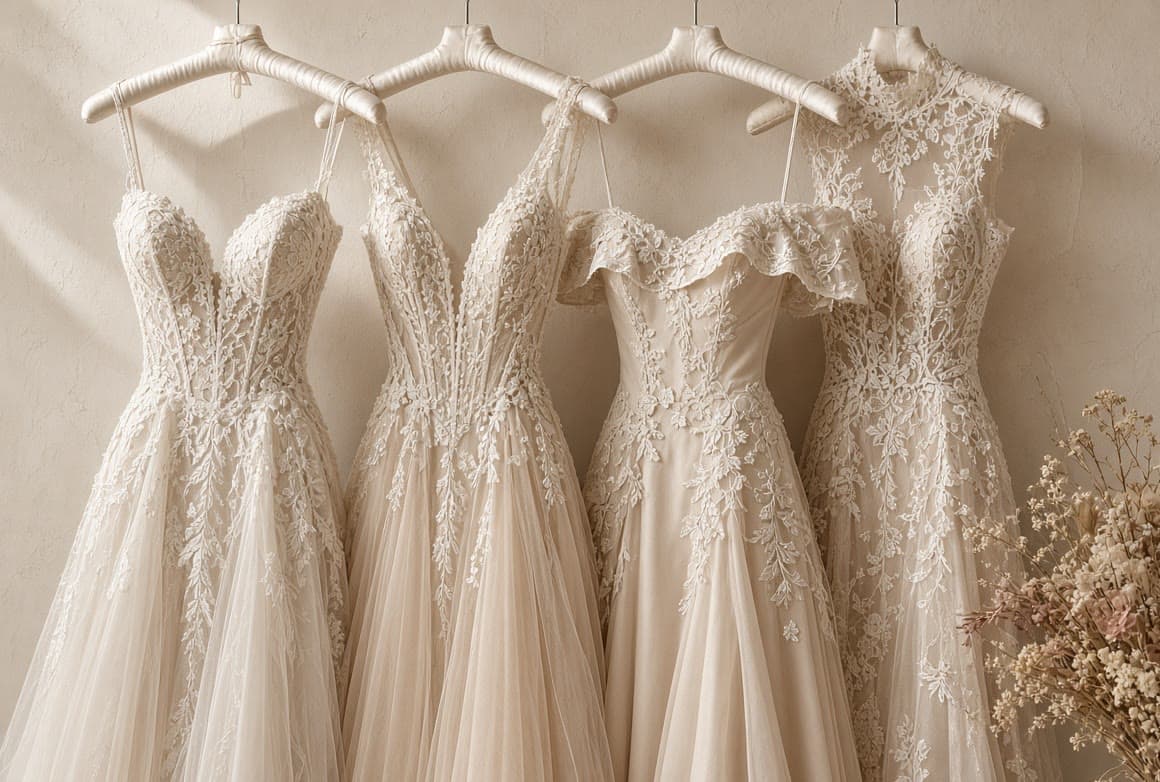
A wedding dress neckline is the first line a guest, and a camera, reads on you. It frames your face, sets the width of your shoulders, and has to last through hugging, sitting, dancing, and raising a glass.
There is no single most flattering cut. Try more than one shape, notice what it does from the jaw to the waist, and test it while you move. Body-shape charts can offer a starting point, not a verdict. For the wider shopping process, see a bride's guide to finding the perfect wedding dress.
How a Neckline Works, From Jaw to Waist
A neckline is a drawn line. A horizontal edge can widen and frame the collarbone. A vertical opening, such as a V, can lengthen the look of the torso. A high or wide cut covers more and sends the eye up or out. Flattering, here, means a line you like on your face and shoulders, plus a bodice that stays put, not a universal ranking.
Strapless versus strapped, and sheer versus solid, are construction choices that can sit on top of a shape. A sweetheart can be strapless or take straps. Support lives in the bodice as much as in the visible edge: seams, cups, boning, and a close fit through the ribcage.
The Main Wedding Dress Necklines, and What Each One Does
The map below is a guide to shape and comfort, not a chart of body types.
| Neckline | The line it draws | Long-day hold | Hair or jewelry hint |
|---|---|---|---|
| Sweetheart | Heart-shaped dip at the center | Needs a close, structured bodice | Flexible hair; necklace or none |
| Semi-sweetheart | The same heart, cut a little higher | A bit more coverage at the chest | Same flexibility as a sweetheart |
| Scoop | A soft U from the shoulders | Straps usually help it stay put | Tucked or half-up hair |
| Cat-eye | Outer edges lift toward the shoulders | Needs structure, or the lift flattens | Hair up or aside |
| V-neck and plunge | A vertical opening, shallow or deep | Straps, sleeves, or an illusion panel help | Follow the V; stay out of a plunge |
| Square | A straight edge with vertical sides | Wider straps are common | Clean hair; short necklace or none |
| Straight-across strapless | A simple horizontal cut, no straps | Fit and boning do all the work | Flexible hair; shorter necklace |
| Bateau | A wide, high line along the collarbone | Sleeves, when present, add support | Hair often looks clearer up |
| Off-the-shoulder | Opens the collarbone below the shoulder | Test reaching and hugging for slip | An updo can show the shoulders |
| Halter | Straps meet behind the neck | Can press at the throat; test comfort | Hair up; usually no necklace |
| High neck | Fabric at or above the base of the neck | Coverage is built in | Hair up; earrings, not a necklace |
| Illusion | Sheer mesh or lace over a deeper shape | Can add coverage and support | Let the overlay lead |
Curved lines: sweetheart, semi-sweetheart, scoop, and cat-eye
A sweetheart, as The Knot's neckline glossary and Brides describe it, dips at the center like the top of a heart. Often strapless, it needs a close bodice; if it creeps down when you raise a glass, the fit is not finished. Those guides more often call the higher version a semi-sweetheart. If you have been looking for a modified sweetheart, that higher-cut heart is usually what people mean, and it can feel calmer on a fuller bust, as Brides notes.
A scoop is a softer U, often with straps and sometimes mirrored on the back, which WeddingWire and The Knot treat as a classic. A cat-eye does the opposite of a dipping heart. You may not see the name in every bridal glossary. Designer Melissa So, writing for Miss Scarlett, describes outer edges that curve upward toward the shoulders, with the center level or gently raised. The lift frames the décolletage only if the bodice holds; if the structure is soft, those edges flatten.
Open and linear: V-neck, plunge, square, and straight-across strapless
A V-neck draws a vertical line that can lengthen the look of the torso; a plunge is a deeper V. Brides and WeddingWire note that many plunges are steadied with an illusion panel. Without one, the cups and a movement test matter more than a last-minute fix. Fashion tape, which The Knot mentions as a backup, is not a substitute for construction.
A square neckline, often with wider straps, is a structured, collarbone-forward frame, as WeddingWire typically shows. A straight-across strapless cut is a cleaner horizontal line with no straps. Strapless describes the missing straps, not a single shape; a strapless bodice may also be a sweetheart. Fit, cups, and boning hold it, not willpower.
Across the collarbone and shoulders: bateau, off-the-shoulder, and halter
A bateau, also called a boat or Sabrina neckline, follows the collarbone out toward the shoulder tips. Sleeves, when present, add support, as Brides notes. An off-the-shoulder neckline can slip, so reach and hug before you decide. If you want the fabric closer to the shoulder, Brides points to a portrait neckline as a related option, a preference, not a rule, including if your shoulders are broad.
A halter meets behind the neck and can press at the throat, so wear it long enough to know. Adding sleeves later is more complicated than adding straps to a strapless gown, according to The Knot's guide to adding sleeves.
Covered and sheer: high neck and illusion
A high neck offers the most coverage of the common bridal cuts, and illusion details can soften the look, as Brides notes. A jewel neckline is a related high, round cut at the throat.
Illusion is both a look and a construction tool. Sheer tulle, mesh, or lace can extend from a deeper bodice toward the neck or over the shoulders and can stabilize a plunge or sweetheart, add coverage for a ceremony that asks for it, and keep a bare effect without a heavy fabric, which is how The Knot describes the mesh. Check it in more than one light. Coverage is a choice, not the only formal one. One-shoulder, Queen Anne, and cowl are related shapes.
Shoulders, Bust, and What the Charts Get Wrong
Body-shape charts are optional starting points. The same person can wear more than one neckline well.
If you have broad shoulders, some guides suggest a V or a slightly closer shoulder line. Others warn that a wide bateau or a very open off-the-shoulder draws the eye outward. Brides offers a portrait neckline as an alternative in that case. If you love a bateau or an open shoulder, try it and look at a photograph.
For a smaller bust or a flatter chest, Michaela Garner, quoted in The Knot's advice on dresses for a smaller bust, offers two valid paths. To accentuate the bust, she suggests a sweetheart, a cowl, or an off-the-shoulder. To lean into a smaller chest, she suggests a halter, a high or mock neck, or a plunging V, and she is clear that a small bust can wear a V-neck. For a fuller bust, a slightly higher edge, such as a semi-sweetheart, can feel more comfortable, as Brides suggests, but support matters more: secure cups and boning, and straps or sleeves when they add ease. A deep plunge or a narrow halter needs a movement test.
Construction, Support, and What a Seamstress Can Change
What holds a neckline is a close bodice, cups, boning, and, when they are part of the design, straps or sleeves. The Knot's alterations guide notes that boning can sometimes be added to help a sleeveless dress stay up, and that straps or sleeves are a common addition. Strapless comfort is mostly fit. Detachable straps can be added later, but they should not rescue a bodice that is already sliding.
Can a seamstress change the neckline? Often, in part. A skilled bridal seamstress can raise, lower, or soften a shape, and can add straps, some sleeves, or an illusion or lace overlay. There are limits. A pre-purchase alterations guide makes those limits plain: a change cannot invent fabric that is not there; opening a neckline can affect boning, cups, or underwire; and heavily boned or beaded bodices are more limiting. A full set-in sleeve on a strapless gown, or a rebuilt halter, is more complex than adding straps.
Confirm any new shape on the actual gown before you count on it. For how fittings work, see wedding dress fittings and alterations. How the fabric behaves can also affect whether a line holds; see wedding dress fabric types.
Hair, Jewelry, and a Fitting-Room Test
Stylist Sarah Koseck, quoted in The Knot's neckline hair guide, says the neckline frames the face, neck, and shoulders, so the hairstyle should work with it. Those pairings are starting points; you can wear your hair down when that still feels like you. Plan the hair and makeup trial after the dress is chosen, and try the dress with the trial style.
For jewelry, one focal point is enough, or none, as The Knot's jewelry guide advises. High neck and halter usually leave the necklace off. Strapless and square can carry a necklace at the collarbone. Sweetheart length is not a settled rule: that same guide leans toward a shorter necklace, or no necklace and statement earrings, while designer Abhi Madan, quoted in The Knot's strapless necklace advice, suggests a slightly longer necklace that follows the dip. Try all three on the dress. A necklace should not fall into a plunge or catch on the bustline. If the neckline is already busy, keep a veil simple; see wedding veil lengths.
Do the fitting-room test in the shoes and undergarments you plan to wear: sit, reach, turn, raise a glass or hug, lean forward, and photograph from the front and the side. Check for gaping, slipping, a neckline that stands away from the chest, and uneven sides. If it only looks right standing still, it is not finished.
FAQ
What is the most flattering wedding dress neckline?
There is not one. Choose the line you like on your face and shoulders, then confirm it stays put.
What neckline works for broad shoulders?
More than one can. A V or a closer shoulder line is a common starting point. A wide bateau or open off-the-shoulder may emphasize width, but that is not a ban. Try them.
What neckline works for a large bust or a small bust?
For a fuller bust, prioritize support and, if you want it, a slightly higher edge. For a smaller bust, you can accentuate the chest or lean into it.
What is the difference between a sweetheart and a modified or semi-sweetheart?
A semi-sweetheart is the same heart shape, cut a little higher. That is usually what people mean by a modified sweetheart.
What is an illusion neckline?
Sheer mesh, tulle, or lace over a deeper or strapless bodice, often with the look of bare skin and some added coverage or support.
Can a seamstress change the neckline of a wedding dress?
Often, within the limits of the bodice, fabric, and beading. Ask on the actual gown.
What necklace works with a sweetheart or a square neckline?
A square often suits a short necklace or a bare collarbone. A sweetheart can take a short necklace, a slightly longer one that follows the dip, or no necklace. Try all three.
What hairstyle goes with a high neck, a square neck, or a cat-eye?
Hair up or off the shoulders is a reliable starting point for a high neck and a cat-eye. A square neckline often likes a clean or half-up line. Wear what still feels like you.
Checklist
- Try two or three necklines, including one you did not plan to like.
- Notice the line from jaw to waist, in a mirror and in a side photograph.
- Check bust and shoulder comfort without treating a chart as a rule.
- Ask what is inside the bodice: cups, boning, and whether straps can be added.
- If you want a neckline change, get a seamstress opinion on the actual dress.
- Test sit, reach, turn, and raise a glass before you commit.
- Plan hair and jewelry after the neckline, and feel free to keep both simple.
A neckline is a quiet piece of architecture. The right one makes the face the point, and then it stays there while you dance.
You do not have to collect every name on the list. Find a line that looks like you, confirm it still looks like you when you sit down, and let the rest of the day have you.