
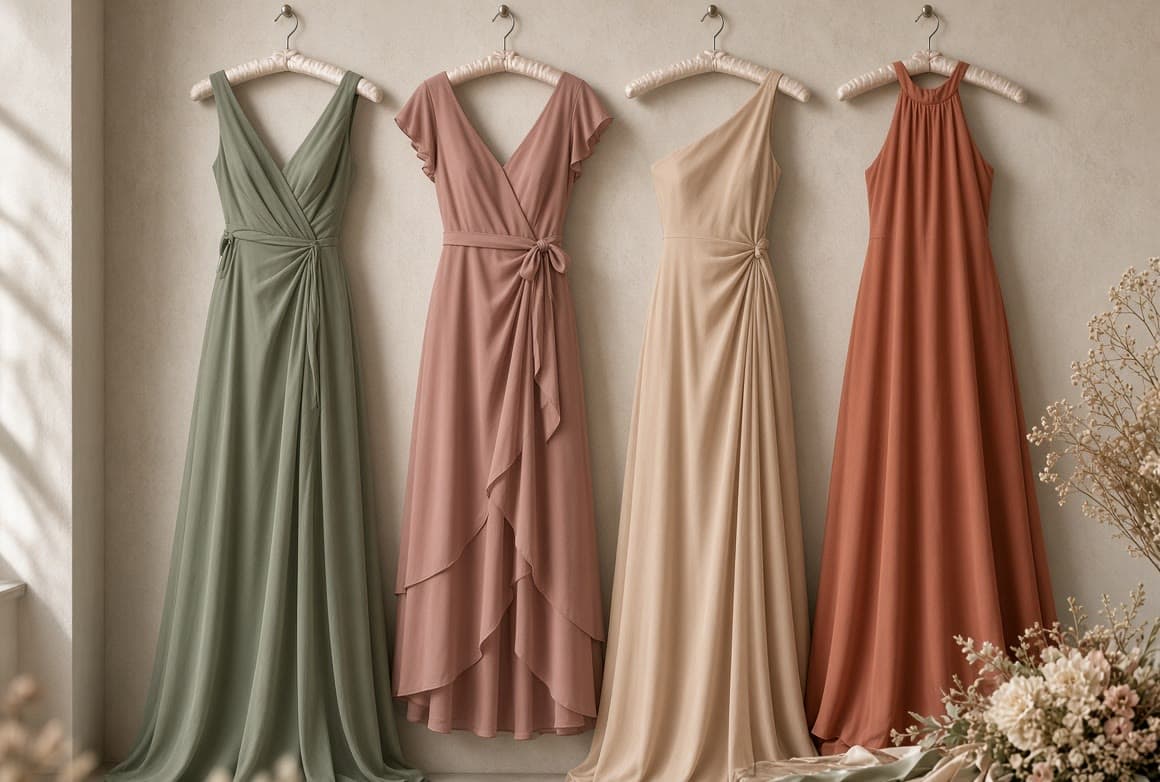
Mismatched bridesmaid dresses are often sold as a simple kindness: let everyone wear what they like. The kindness is real. The craft is quieter. Decide what stays the same, so the differences read as intentional when the line forms at the altar.
No, bridesmaid dresses do not have to match. Yes, they can still look planned. How to do mismatched bridesmaid dresses is less about shopping freely than about choosing one or two anchors, then giving the party real room inside them.
You can still choose matching dresses if that is the wedding you are hosting. A matched row can be a kind of devotion too.
Matching or Mismatched, and Which Wedding Each Suits
Both approaches can look beautiful. The map below is a guide, not a set of rules.
| Approach | Often suits | What to hold still |
|---|---|---|
| Matching dresses | A formal or uniform vision, or a glam ballroom | Color, cut, and fabric |
| Same color, different styles | A party of different bodies who still want one clear hue | Color, and usually fabric or length |
| A short palette, different styles | A less formal day, or a larger party in several shades | A color family, fabric, or hem |
Matching has not been retired. Grace Lee Chen, founder of Birdy Grey, quoted in The Knot's guide to coordinating mismatched looks, says you cannot go wrong with a uniform look, even as more groups now mix fabrics, hems, and palette. A glam ballroom may want the evenness of one deep color. An outdoor spring wedding may welcome florals and a lighter hand.
Venue and formality should steer fabric and cut, not only color. The Knot's advice on choosing dresses the party will not hate points to breathable clothes in the heat, and wraps if the dresses are sleeveless in the cold. Mixing shades of one color, The Knot notes, works especially well for larger parties. Ask the group what would make them feel comfortable.
The Anchors: What Stays the Same
The real work of a mix-and-match bridesmaid look is deciding what will not move. Name one or two anchors: a color family, a fabric or a similar sheen, a shared hem length, or a shared silhouette.
Kate Boswell, The Knot's fashion editor, and Brides' guide to a cohesive mismatched party both advise varying just one or two elements. Same color with different silhouettes, or a short palette with a shared fabric or length, are the usual calm versions.
Fabric consistency matters. Kelsey Doorey, quoted in WeddingWire's mix-and-match advice, warns that a glam gown beside a boho sheath, or velvet beside chiffon, can confuse the eye. If fabric or sheen is your anchor, our guide to wedding dress fabric types can help you think about how cloth behaves in light and heat. It is written for bridal gowns, not as a bridesmaid shopping list.
A same-color mismatch is often the simplest intentional look. A family of shades is the next step, not a free-for-all of unrelated hues. Prints can work if a print you love supplies the throughline colors for the solids, which is Lee Chen's advice in The Knot.
A Short Palette, and How to Check the Color
Build a short palette of about two or three shades, not a rainbow. WeddingWire advises three shades at most; a natural example is pink, then blush, rose, and carnation. Stylist Beverly O, quoted in Brides' color guide, offers a blue example: powder blue, navy, and cobalt, chosen for the people wearing them. Green may appear only in a passing venue example, such as dark sage.
Order swatches, because color can look different online, as The Knot notes. Then, if you can, look at full-size samples side by side. Brides warns that a small swatch can also differ from a gown. In my own practice, I compare those swatches and samples in daylight, or in light like the venue's. Treat that as a practical habit, not a formal rule.
Shopping from one collection can reduce shade-name drift, as Brides notes, because one house may have only one interpretation of navy. If an exact match matters, order together, because dye lots can vary, which The Knot's bridesmaid dress timeline also flags.
Necklines, Silhouettes, and Different Bodies
Once the anchors are set, silhouette and neckline are the kindest places to give choice. A neckline can be mixed to suit shoulders, a bust, or a wish for more coverage, while the palette or fabric stays put. For a closer look at those shapes, see wedding dress necklines.
Ask before you lock a tight, strapless, or very high-slit style that someone would never wear otherwise. The Knot notes that kind, small alterations, such as adding a sleeve or raising a neckline, can help without undoing the plan. Check that the options actually come in the sizes your party needs.
How Much Choice to Give, Who Pays, and When to Order
Can bridesmaids pick their own dresses? Yes, inside a frame. A curated shortlist, or clear guidelines, is kinder than a fully open shop. Brides warns that sending everyone off with only a color can backfire: you may get six versions of "navy" that do not agree. Pre-select styles, share swatches, and make a mood board. Brides offers 10 to 15 dress options as one example range, not as a rule. Boswell and Nayri Kalayjian, founder of Wedding Fashion Expert, quoted in The Knot's recent bridesmaid trend coverage, want some approved styles, so there are no surprises. Still give a real say on fit and comfort.
If you want wording for that note, here is an original example, not a required script: "Please choose from these options, in this color family, floor length, in a similar matte fabric. Send me a photo before you order."
Do bridesmaids pay for their own dresses? In the US, typically yes, including shoes, accessories, and alterations, even when you chose the look, as The Knot, Emily Post, and Zola all describe. Say so early, as Emily Post advises. You may pay, help, or split a dress if that is kinder. Mismatching inside a palette can let each person spend what she can. Our wedding budget checklist already notes color guidelines as a way to keep costs kinder. Zola also notes that in the UK and Ireland, the bride or couple more often pays.
When should the dresses be ordered? Follow The Knot's timeline: about eight months out, share the anchors; about six months out, order, sooner if a maker needs longer. Book alterations three to four months out, and complete them about four to six weeks before, with shoes in hand. For the shorter bridesmaid version of that clock, see the wedding dress alterations timeline.
How It Reads in Photographs, and in the Line at the Altar
The test is the line, not the hanging bag. Hem length is the main thing photographs will notice. Brides says different lengths are acceptable if the mix is balanced; if everyone is long except one person, or the reverse, photos may look awkward. If you already vary color, hold the hem still. If you vary length, keep the mix even.
The maid of honor can be distinguished by fabric texture, a possibility The Knot names, or simply by where she stands. She often walks alone and stands near the bride; see wedding processional order.
See the group together, on a mood board or in samples, before anyone is beyond a return or an exchange.
What Ties the Group Together
Coordinated bouquets are the clearest shared tie in both Brides and WeddingWire. If the dresses use several shades, those shades can recur in the flowers.
Hair and makeup are kinder when they stay in one family. Jessica Janik, quoted in WeddingWire, notes that a few smoky eyes in a natural group can throw the line off. For the getting-ready clock, see the hair and makeup timeline.
Shoes and jewelry are a genuine disagreement. Brides likes a shared accessory, such as a necklace or a hairpiece. The Knot advises against dictating a specific, expensive shoe, and treats mixed jewelry as more modern. A calm middle is enough: agree on a finish, such as metallic shoes or a shared metal, or offer a small gifted piece. You do not need one shopped-identical set, or one mandated shoe.
Malinda Macari, quoted in WeddingWire, suggests the same color in ties, bow ties, socks, or pocket squares, so the two sides of the aisle still read as one party. Formality should match.
When Mismatched Bridesmaid Dresses Go Wrong
This is not a shame gallery. Too many variables at once is the usual trouble. Lee Chen, quoted in The Knot, warns about one person arriving in black and another in a ruffled pink number. Brides cautions that six versions of "navy" will not agree if you send people off with only a color name. Doorey, in WeddingWire, flags clashing fabric or formality: velvet beside chiffon, or a glam gown beside a casual sheath. An unbalanced hem can do the same work in photographs.
The fix is almost always simpler, not stricter: fewer variables, swatches, a shortlist, and someone kindly overseeing the final group. You have permission to simplify.
What a Varied Line Can Say
The point of a varied line is not fashion for its own sake. It is that the people standing with you do not have to be made identical in order to belong together.
The friendships in that row are already mismatched, in the best sense: different ages, bodies, budgets, and tastes, held by one loyalty. The clothes can tell that truth quietly, if you give them a few things in common. Matching can be a kind of devotion too.
FAQ
How do you do mismatched bridesmaid dresses so they look intentional?
Choose one or two anchors, build a short palette, and give the party a real choice inside that frame.
Do bridesmaid dresses have to match?
No. Matching is still a beautiful option. Mismatching is a planned variation, not a free-for-all.
Should bridesmaids wear the same color?
They can share one color, or a short family of shades. What they should not do is arrive in unrelated hues with no common thread.
Can bridesmaids pick their own dresses?
Yes, inside guidelines, a shortlist, or a small set of approved options. A completely open brief is how a line goes accidental.
Do bridesmaids pay for their own dresses?
In the US, typically yes, including alterations, unless the couple offers to help or to pay. Say so early.
When should the dresses be ordered?
Plan the look about eight months out, and order about six months out, unless a maker needs longer. Leave time for alterations.
Are mismatched bridesmaid dresses still in style?
Recent coverage from The Knot still treats them as current, and matching as valid.
How do you keep them from going wrong?
Hold one or two things still, check color in real cloth, and look at the group together before the orders are final.
What about the groomsmen?
Keep the same formality, and repeat the palette in ties or pocket squares if you want the two sides to meet.
Checklist
- Decide whether the party will match, share one color, or share a short palette.
- Choose one or two anchors: color family, fabric, hem, or silhouette.
- Pull two or three shades, and compare swatches or samples in good light.
- Offer a shortlist, or clear guidelines, and still ask about fit and comfort.
- Say, early, who is paying, and set the order date, with alterations and shoes in mind.
- Plan the ties: bouquets, a shoe or jewelry finish, and a hair and makeup family.
- Look at the whole line, including the honor attendant's place, before anyone is past a change.
A mismatched line works when it is designed, not when it is left to chance. The differences are the point, but only after a few things have been asked to stay.
If the row looks like itself, a little varied and still clearly one party, you will have done the quiet work. The people you love will stand there as they are, and the altar will not have to pretend they were ever the same person in different sizes.