
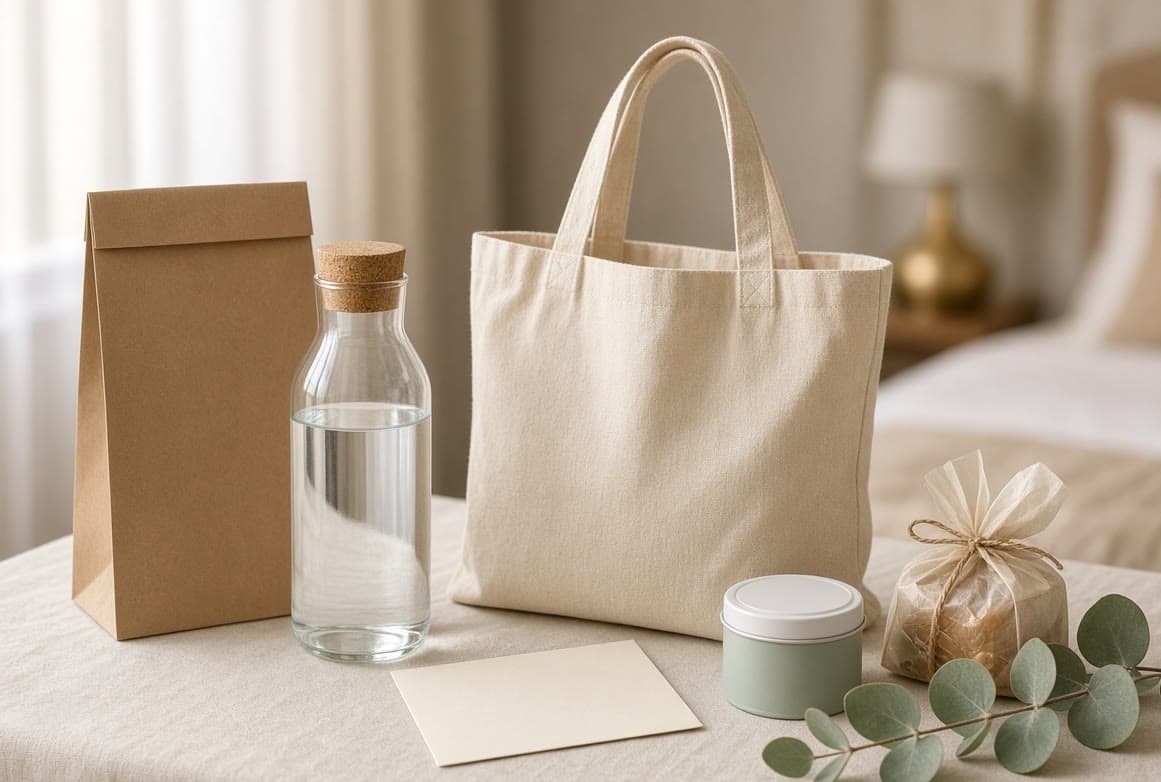
What to put in wedding welcome bags is a smaller question than it appears. A welcome bag is not a second reception, and it is not a favor. It is the couple's first act as hosts, waiting in a hotel room or at a check-in desk, and it sets the tone of the weekend before the ceremony begins.
You do not have to make them. If you do, fill them in layers, not with fifty items: a note and the weekend's facts, water and a snack, then one personal or local thing if you want it.
Favors, when you use them, are a farewell at the end of the night. These bags are a beginning-of-weekend kindness for people who have traveled, or who are staying over. For the farewell question, see Do You Need Wedding Favors?.
Do You Need Wedding Welcome Bags?
Brides is plain: welcome bags "are in no way required." Zola agrees they are not required. The Knot calls this "a bit of hospitality" that "isn't always a must-have."
They help most when guests have used a vacation day, a flight, or a night in a hotel block, or when the wedding is a destination or a multi-day weekend. The Knot's welcome-bag guide frames them as a thank-you for traveling, and as a way to help people feel at home in a hotel room. That is a reason to make them, not a rule that every wedding must have them.
A mostly local, one-day wedding can skip them without being ungracious. An itinerary on the website, and a kind greeting at the door, can do the host's work. You have permission to simplify.
Who Gets a Welcome Bag
If you are making bags, McKenna Folmar, a wedding planner quoted in Zola, recommends providing them for all out-of-town guests, and considering local guests only if the budget allows, especially those staying overnight or attending the full weekend.
In my practice, I plan one bag per room for guests in the hotel block, packed with enough water and snacks for two when a couple is sharing. That keeps cost and hotel delivery manageable.
Known out-of-town guests booked outside the block still deserve the same kindness if you can deliver it. In my practice, if I cannot get a bag to their door, I bring a few extras to the welcome party or rehearsal dinner. I do not treat a missed bag as a failure when someone booked without telling me.
If two unrelated adults share a room, in my practice I like to give each person a bag if the budget allows. Otherwise one generously packed bag is still a welcome. Local guests who are going home at night do not need a bag. A printed itinerary at a welcome party can be enough.
What to Put in Wedding Welcome Bags
What to put in wedding gift bags for hotel guests, or in any welcome bag, is a short stack of layers, not a shopping list. The map below is a guide, not a rule chart.
| Layer | What belongs | Why it helps |
|---|---|---|
| Useful | A welcome note, a weekend itinerary, a map or local pointers, and a contact who is not the couple | Guests know where to be, and whom to ask |
| Comfort | Water, a snack, and a small recovery kit (pain reliever, electrolytes, mints) | Arrival hunger, thirst, and the morning after |
| Personal | One local or meaningful item | The bag feels like this wedding, not a gift shop |
The useful layer does the real host's work. The Knot and Zola both come back to a welcome note and a printed itinerary, with times, addresses, and, if you have them, shuttle or transportation details. Jamie Kutchman Wynne, quoted in Brides, puts it simply: you never want anyone to miss a shuttle because the pickup time was unclear. Add a map or a few local pointers, and a contact for questions so they do not all land on you.
Comfort is what people reach for first. Water is the staple, as The Knot and Zola both note. A local snack is lovely; a simple shelf-stable snack is enough. Brides is honest here: edible and practical items will almost always be more appreciated than a decorative extra. A small recovery kit, with a pain reliever, electrolytes, and mints, is the kindness guests remember the morning after.
Seasonal swaps live in the comfort layer, as a practical change, not a trend. Folmar, in Zola, suggests sunscreen, bug spray, and fans in warm weather, and extras such as hand warmers when it is cold. Lip balm belongs in that same winter group.
The personal layer is one item, not a second bag: a local treat, or something that is meaningfully yours. Stop after the useful layer plus water and a snack if that is kinder. Five thoughtful things beat a stuffed tote. Alcohol is optional, not required, and not right for every guest or every hotel. If a hotel declines perishable or alcoholic items, respect that.
How to Write the Welcome Note
The note is the most important piece of paper in the bag. Thank your guests, especially for traveling, point them to the itinerary, and keep it short, in your own voice. Handwritten is lovely. A printed note that you sign is enough, which is Zola's practical advice.
Wynne, in Brides, suggests starting about a month or two ahead, printing the letter, and leaving extra copies at the front desk. The bag note can be shorter than a full welcome letter, with the itinerary on a separate card.
If you want a starting page, here is original example wording, not a required script:
"Welcome, and thank you for making the trip. We are so glad you are here. The card in this bag has the weekend's times and addresses. Rest well tonight. We cannot wait to celebrate with you. Love, [Names]"
"Thank you for being here this weekend. We left a few useful things for the room. If you need anything, the front desk has our coordinator's number. See you soon. [Names]"
"Welcome to the weekend. It means the world that you came. Help yourself to the water and snacks, and keep the itinerary handy for times and rides. We are so glad you are with us. [Names]"
How Much to Spend, and Who Pays
How much to spend on wedding welcome bags depends on what you put in them, not on a single magic number. The Knot says a bag "can cost as little or as much as you'd like," that "spending between $5 to $15 per person is reasonable," and that the "low-cost range" is "anywhere between $7 and $20." Local or luxury items, The Knot notes, will raise the per-person cost.
Those figures are framed per person. Many couples pack one bag per room, so a shared room will not always match a per-person line. Costs also vary with packaging, and with any hotel handling fee. In its 2024 guide to hidden wedding costs, The Knot reports that delivery fees can run up to $7 per bag, a reported ceiling that varies by hotel. Ask before you budget the last dollar.
There is no official rule about who pays for wedding welcome bags. If you and your partner are paying for the wedding, the bags typically fall to you. Parents who are helping may offer, or be asked, which is the same picture in The Knot and in Brides.
If you need a home for the line item, see the wedding budget checklist. The kindest way to spend less is to put fewer, more useful things in the bag, not to hunt for a cheaper trinket.
Bags, Boxes, and How They Look
Bags and boxes are both standard. Brides describes welcome bags as typically packed in a reusable tote or a cardboard box. Zola offers the same range, and notes that a tote can live a second life, though it may be the more expensive choice. A simple paper bag or a sturdy box is enough, and boxes can be easier for guests who are flying. Baskets often travel badly, so they are a poor default for anyone packing a suitcase.
Choose a container that holds the layers and can be labeled with the reservation name. You do not need a catalog of totes.
Hotel Logistics: Front Desk or Room Delivery
Have the bag ready when guests arrive. The usual choices are all workable: the front desk hands it over at check-in; the hotel delivers it to the room; you or a trusted person distribute bags after arrival; or a table at the welcome party catches everyone at once. The Knot and Zola both describe those hotel options. Folmar, in Zola, notes that most couples have the bags delivered to the hotel, placed in rooms or handed out at check-in.
Ask the hotel early, ideally when you book the block. Confirm whether room delivery is offered, what it costs, whether there is a holding fee for early drop-off, where to leave the bags, and how they should be labeled. As The Knot's 2024 hidden-costs guide reports, delivery fees can run up to $7 per bag, the charge may not appear unless you ask, and a front-desk handout may be free or cheaper. Treat that as a reported ceiling. The policy will vary by hotel.
Drop the bags off before guests arrive, labeled with the reservation name. For a destination weekend, Zola advises assembling after you arrive, so nothing is crushed in transit.
If guests are split across hotels, or booked outside the block, the welcome-party table is the calm backup.
FAQ
What should you put in wedding welcome bags?
A note, an itinerary, a map or contacts, water, a snack, and, if you want, a small recovery kit and one personal or local item.
Are wedding welcome bags necessary? Do you need welcome bags for a wedding?
No. They are a kindness, most helpful for out-of-town and hotel guests, and for destination or multi-day weekends.
Who should get one?
If you make them, plan on one per room for guests in the hotel block, and include other known overnight travelers if you can deliver the bag.
What about guests booked outside the hotel, or local guests?
Try to include out-of-town guests you can reach, or bring extras to a welcome party. Local guests who are not staying over do not need a bag.
How much should you spend?
The Knot calls $5 to $15 per person reasonable, and describes a low-cost range of $7 to $20, with fancier items costing more. Hotel handling may add a per-bag fee. Spend on useful layers, not on volume.
Who pays for wedding welcome bags?
Usually the couple, especially if they are paying for the wedding. Parents who are helping may offer.
What should the welcome note say?
Thank them, especially for traveling, and point them to the itinerary, in your own voice, in a few sentences.
Bags or boxes?
Either, or a reusable tote. A simple bag or box is enough. Baskets are a poor choice for guests who are flying.
When should the bags be delivered?
Ready on arrival: at the front desk, in the room, or at a welcome event. Ask the hotel about fees before you decide.
Checklist
- Decide whether bags will help this weekend, or whether you can skip them.
- If you are making them, list rooms in the block, and any other overnight guests you can reach.
- Pack in layers: note and itinerary, water and a snack, then one comfort or personal extra if you want it.
- Write a short welcome note, and print extra copies for the front desk.
- Choose a simple bag or box, and label each one with the reservation name.
- Ask the hotel, early, about front-desk handout, room delivery, holding fees, and drop-off.
- Bring a few extras to the welcome party for anyone you could not reach.
- Give yourself permission to keep the bag small.
A welcome bag does not have to be elaborate. It has to feel like a host was thinking about the guest before the guest had even put down a suitcase: here is water, here is the plan, here is a little of this place, we are glad you came.
If you make one, keep it useful, and let it arrive in time to be used. If you skip it, the weekend can still be warm. Either way, the first kindness is the same: guests should feel expected, not managed, before the ceremony begins.